

Disease Overview
The hepatitis A virus is a single serotype, ribonucleic acid virus of the Picornaviridae family, and usually causes clinical hepatitis in adults and older children. Most infected people develop non-specific constitutional signs and symptoms followed by gastrointestinal symptoms.1,2
Hepatitis A is transmitted via the fecal–oral route, which can occur from:1
- Direct person-to-person contact
- Contamination of the environment or objects
- Contaminated food or water
- Infected blood or blood products
Cases are typically infectious 2 weeks before the onset of symptoms and remain infectious until 1 week after the onset of jaundice.1
Symptoms
Symptoms appear after an incubation period of 15 to 50 days (average 28 days):1,3
- Fever
- Dark urine
- Loss of appetite
- Fatigue
- Nausea and vomiting
- Stomach cramps or abdominal pain
- Jaundice
Risk Factors
People at increased risk of infection or severe hepatitis A
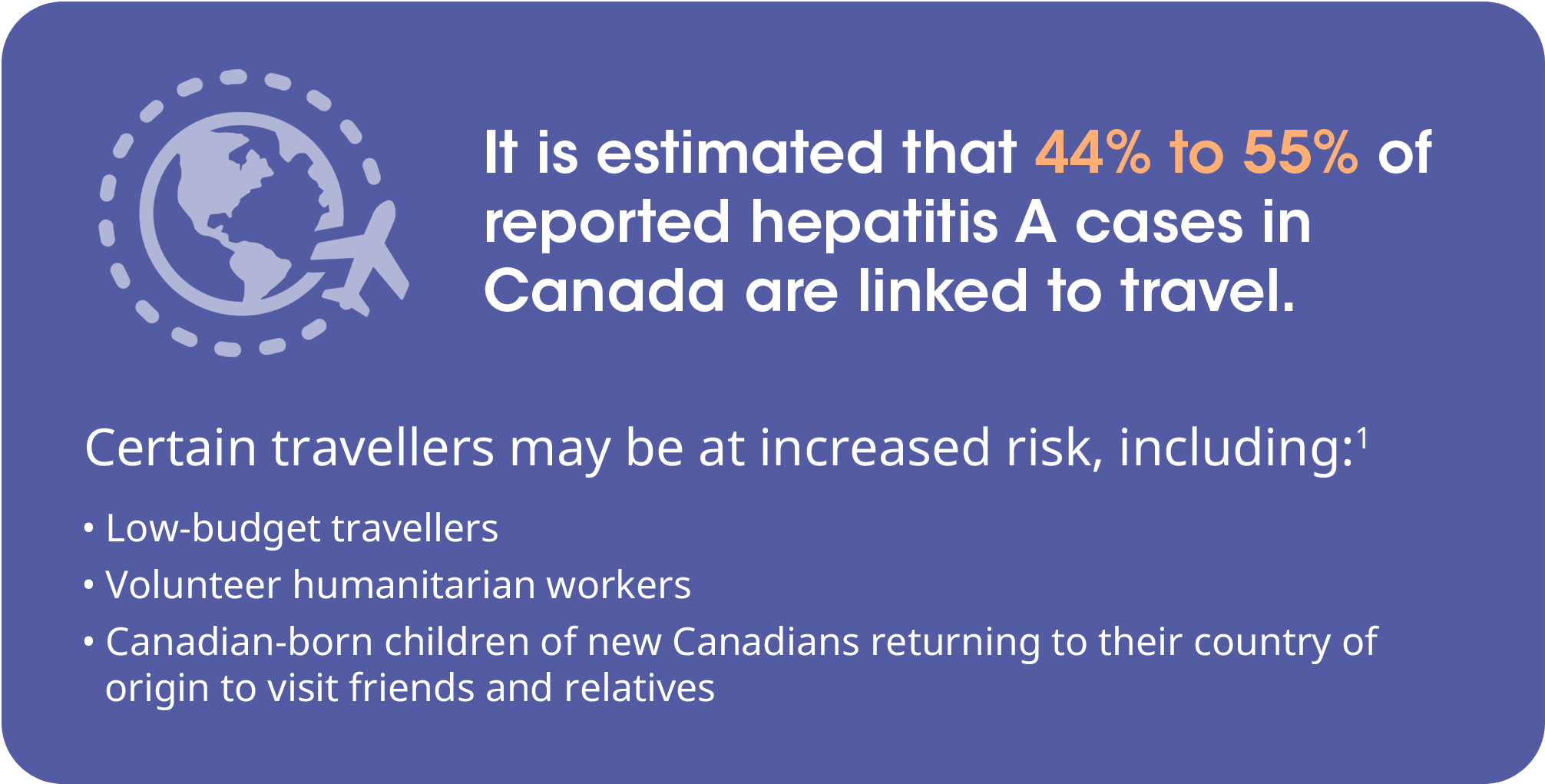
Other risk factors1

-
People living in communities at risk of outbreaks or where hepatitis A is endemic.

- Household or close contacts of children adopted from countries where hepatitis A is endemic.

- Men who have sex with men.

- People who engage in disordered use of injectable and non-injectable substances.

- Workers involved in research on the hepatitis A virus or production of hepatitis A vaccines.

- Military personnel and humanitarian relief workers who are likely to be posted to areas with high rates of hepatitis A.

- Zoo-keepers, veterinarians and researchers who handle non-human primates.

- People receiving repeated replacement of plasma-derived clotting factors.
Some people are at an increased risk of severe illness or complications from hepatitis A infection, including those:1

-
With chronic liver disease

-
Over 60 years old
In Canada and Around the World
In Canada, an annual average of 263 cases of hepatitis A were reported in the 10-year period between 2014 and 2023.4
Worldwide, the World Health Organization estimates that there are 1.5 million cases of hepatitis A every year. In high endemic areas (parts of Africa and Asia), almost all infections occur in children.5
Although developed countries such as the United States and Australia are considered low risk areas, outbreaks of hepatitis A continue to occur. These outbreaks cause significant public health problems worldwide, including socio-economic consequences.5
|
*Surveillance data was obtained from EPIWATCH, an open source epidemic observatory established by the Australian National Health and Medical Research Council. EPIWATCH sources range from Google News alerts and news releases from public health agencies such as the WHO and TEPHINET. |
NACI Vaccine Recommendations
Hepatitis A is one of the most common vaccine-preventable illnesses in travellers.1
The National Advisory Committee on Immunization (NACI) recommends immunization for:1
- People >6 months old at increased risk of infection or severe hepatitis A.
- All travellers to hepatitis A-endemic countries, especially to rural areas or places with inadequate sanitary facilities.
NACI also encourages immunization for people who wish to decrease their risk of acquiring hepatitis A.
- National Advisory Committee on Immunization. Hepatitis A vaccine: Canadian immunization guide. November 20, 2023. https://www.canada.ca/en/public-health/services/publications/healthy-living/canadian-immunization-guide-part-4-active-vaccines/page-6-hepatitis-a-vaccine.html
- Government of Canada. For health professionals: Hepatitis A. March 15, 2021. https://www.canada.ca/en/public-health/services/diseases/hepatitis-a/for-health-professionals.html
- Government of Canada. Symptoms of hepatitis A. May 31, 2018. https://www.canada.ca/en/public-health/services/diseases/hepatitis-a/symptoms.html
- Government of Canada. Notifiable diseases online: reported cases from 1924 to 2023 in Canada, hepatitis A. https://diseases.canada.ca/ndis/charts.php?c=pl. Accessed 14 July 2025.
- Lesmanawati DAS, Adam DC, Hooshmand E, et al. The global epidemiology of hepatitis A outbreaks 2016-2018 and the utility of EpiWATCH as a rapid epidemic intelligence service. Glob Biosecur. 2021;3(1).
Sanofi, 1755 Steeles Avenue West, Toronto, Ontario M2R 3T4
© 2025 Sanofi Pasteur Limited. All rights reserved.
MAT-CA-2201025-v1.0-07/2025

View-SoloSTAR®-video-(EN)

View-DoubleSTAR®-video-(EN)
.jpg/jcr:content/image%20(1).jpg)
View-SoloSTAR®-video-(FR)
.jpg/jcr:content/image%20(2).jpg)
View-DoubleSTAR®-video-(FR)
.jpg/jcr:content/image%20(3).jpg)