

Typhoid Fever
What is typhoid fever?
Typhoid fever is caused by Salmonella enterica serovar Typhi bacteria, generally called Salmonella Typhi. Exposure is usually through consuming food or water that has been contaminated by feces or urine of people with the disease or who are chronic S. typhi carriers.1,2
The clinical course ranges from mild illness with low-grade fever to severe systemic disease with abdominal perforation and extra-intestinal infection.2
What are the symptoms of typhoid fever3?
- Fever
- Cough
- Malaise
- Vomiting
- Abdominal pain
- Headache
- Constipation
- Rose spots on the trunk
Serious cases, with symptoms such as abdominal perforation and extra-intestinal infection, can lead to death.3
Vaccines are not used to treat typhoid fever or its complications, such as abdominal perforation, extra-intestinal infection, or death.
Who is at risk of typhoid fever when travelling?
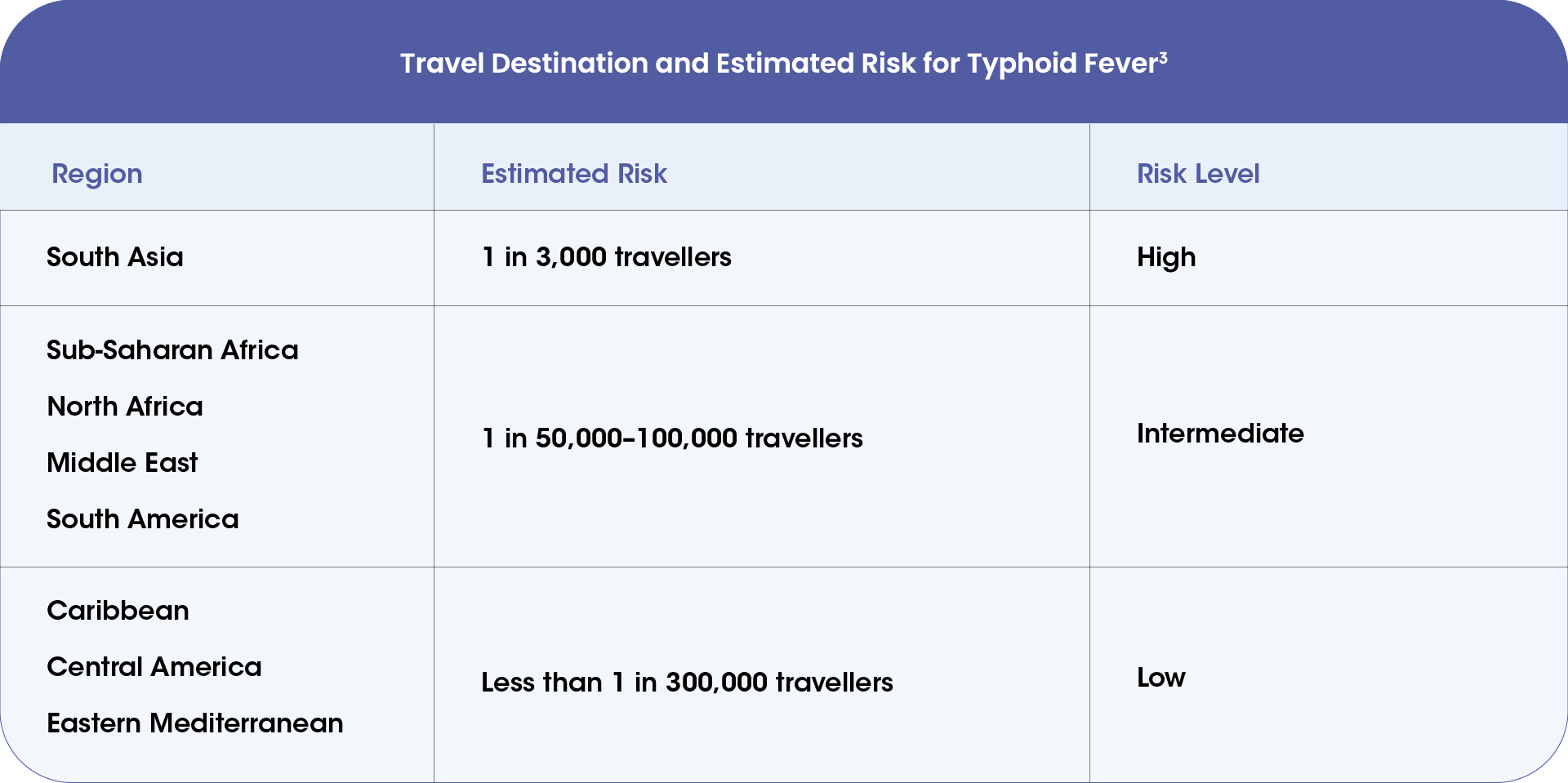
The strongest and most consistent predictor of typhoid fever risk in travellers is destination and the majority of cases of typhoid fever in high-income countries occurs among travellers returning from endemic areas in low- and middle-income countries.3
What are additional risk factors for travellers?3
- People with anatomic or functional asplenia (from sickle cell disease).
- Travelling children.
- Longer duration of travel.
- Presence of achlorhydria or use of acid suppression therapy.
- Travellers visiting friends or relatives.
How many typhoid fever cases are there in Canada, and worldwide?
In Canada between 2012 and 2021, there was a yearly average of 140 cases of typhoid fever. A study in Quebec showed that more than 90% of cases were in people visiting family or friends abroad.3,4
Globally, the World Health Organization estimates that there have been 11–21 million cases with approximately 128,000–161,000 deaths yearly. While most cases have occurred in South Asia and sub-Saharan Africa, there have also been large outbreaks and high incidence in many island nations of Oceania.1,3
What proportion of children get typhoid fever?
Typhoid fever disproportionately affects children between 5 to 15 years old. Studies in children in Asia and Africa estimate that proportions of typhoid fever are:1
- 14–29% in those <5 years old.
- 30–44% in those 5–9 years old.
- 28–52% in those 10–14 years old.
Do I need a typhoid vaccine? NACI Travel Recommendations by Country
The National Advisory Committee on Immunization (NACI) recommends vaccination against typhoid fever for most people ≥2 years old travelling to South Asia, including:3
- Afghanistan
- Bangladesh
- Butan
- India
- Maldives
- Nepal
- Pakistan
- Sri Lanka
The risk of typhoid fever is highest in travellers to India, Pakistan and Bangladesh.3
- World Health Organization. Typhoid vaccines: WHO position paper, March 2018 - Recommendations. Vaccine. 2019;37(2):214–216.
- Government of Canada. For health professionals: Typhoid fever. November 22, 2019. https://www.canada.ca/en/public-health/services/diseases/typhoid-fever/for-health-professionals.html
- National Advisory Committee on Immunization. Typhoid vaccine: Canadian immunization guide. September 8, 2023. https://www.canada.ca/en/public-health/services/publications/healthy-living/canadian-immunization-guide-part-4-active-vaccines/page-23-typhoid-vaccine.html
- Government of Canada. Notifiable diseases online: reported cases from 1924 to 2021 in Canada, typhoid. https://diseases.canada.ca/notifiable/charts?c=pl. Accessed 1 February 2024.
Sanofi, 1755 Steeles Avenue West, Toronto, Ontario M2R 3T4
© 2026 Sanofi Vaccines Canada Ltd. All rights reserved.
MAT-CA-2500561-v1.0-09/2026
View-SoloSTAR®-video-(EN)

View-DoubleSTAR®-video-(EN)
.jpg/jcr:content/image%20(1).jpg)
View-SoloSTAR®-video-(FR)
.jpg/jcr:content/image%20(2).jpg)
View-DoubleSTAR®-video-(FR)
.jpg/jcr:content/image%20(3).jpg)