


Toujeo® is indicated for the treatment of diabetes mellitus in adults, adolescents and children from the age of 6 years 7
Prescribing information can be found at the top of this page
For patients with T1DM or T2DM who need basal insulin, Toujeo® helps provide a balance between effective HBA1c control and risk of hypoglycaemia1-6
For more information please refer to the Summary of Product Characteristics. Additional information is available on request.
Licence: for the treatment of diabetes mellitus in adults, adolescents and children from the age of 6 years.
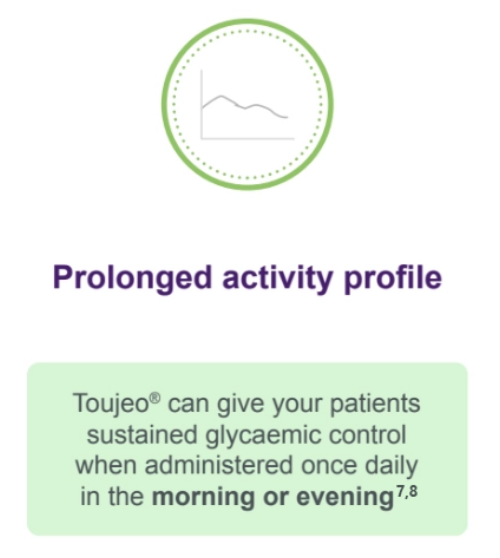
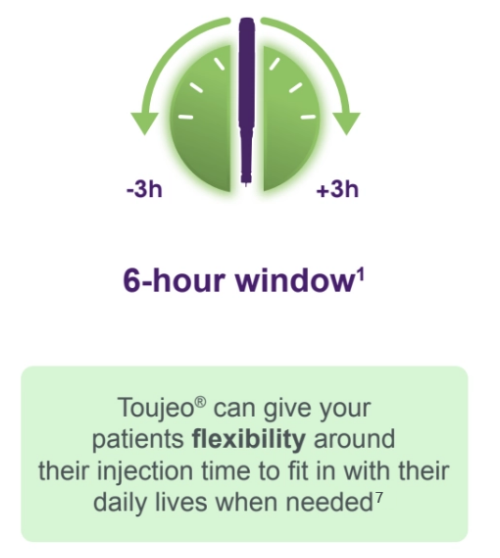
Administration: once-daily administration at any time of the day, preferably at the same time each day but with a 3-hour dosing window when needed. Toujeo’s dose regimen should be adjusted according to individual response.
Toujeo is administered subcutaneously by injection in the abdominal wall, the deltoid or the thigh. Injection sites must be rotated within a given injection area from one injection to the next in order to reduce the risk of lipodystrophy and cutaneous amyloidosis
Adverse events: Hypoglycaemia, in general the most frequent adverse reaction of insulin therapy, may occur. If the insulin dose is too high in relation to the insulin requirement. Lipohypertrophy and injection-site reactions are common adverse events.
Special warnings: Insulin overdose may lead to severe and sometimes long-term and life-threatening hypoglycaemia.
The time of occurrence of hypoglycaemia depends on the action profile of the insulins used and may, therefore, change when the treatment regimen is changed. Particular caution should be exercised, and intensified blood glucose monitoring is advisable in patients in whom hypoglycaemic episodes might be of particular clinical relevance.
To improve the traceability of biological medicinal products, the name and the batch number of the administered product should be clearly recorded.
Cases of cardiac failure have been reported when pioglitazone was used in combination with insulin, especially in patients with risk factors for development of cardiac heart failure.
Medication errors have been reported in which other insulins, particularly rapid-acting insulins, have been accidentally administered instead of long-acting insulins. Insulin label must always be checked before each injection to avoid medication errors between Toujeo and other insulins.
Insulin administration may cause insulin antibodies to form. In rare cases, the presence of such insulin antibodies may necessitate adjustment of the insulin dose in order to correct a tendency to hyper-or hypoglycaemia.
Intercurrent illness requires intensified metabolic monitoring. In many cases urine tests for ketones are indicated, and often it is necessary to adjust the insulin dose.
Switching a patient between another type or brand of insulin and Toujeo should be done under strict medical supervision and may necessitate a change in dose.
Starting and switching to Toujeo

Explore practical guidance for starting and switching to Toujeo

Access digital and hard-copy materials for your patients
Switching from GLP-1RA to a basal insulin
Download these resources to assist you in starting Toujeo Solostar in a patient currently prescribed a GLP-1RA for whom insulin might be an option.
Medical supervision with close metabolic monitoring is recommended during any switch of therapy or initiation of insulin, and in the initial weeks thereafter.
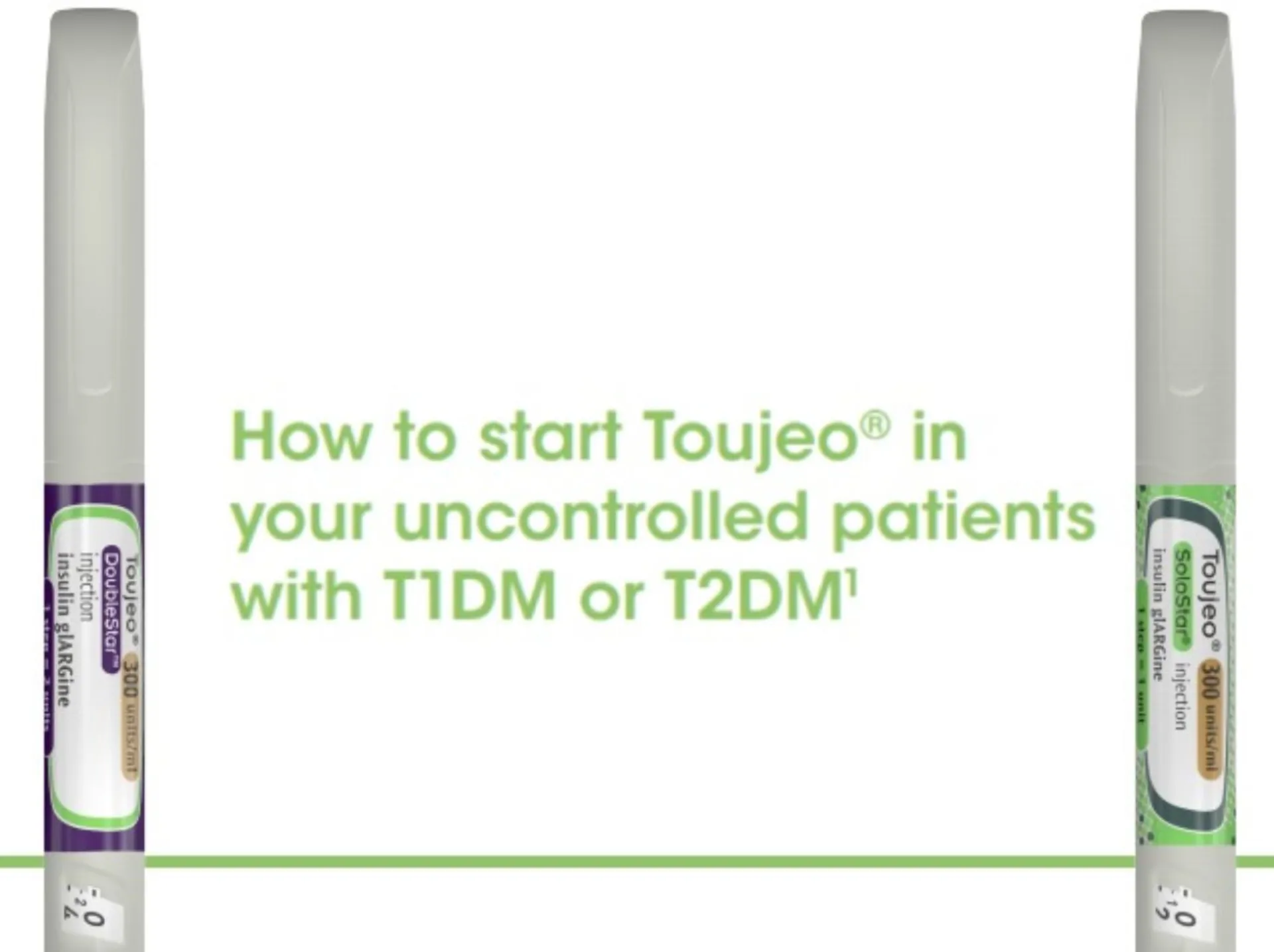
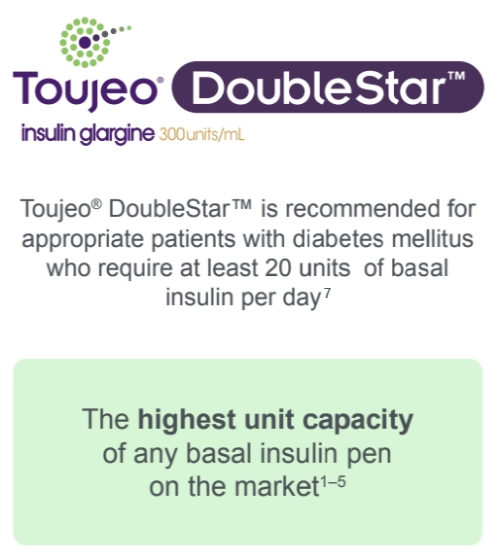
Toujeo Features
Support

Diabetes Products


T1DM – Type 1 Diabetes
T2DM – Type 2 Diabetes
- Danne T, Matsuhisa M et al. Lower risk of severe hypoglycaemia with insulin glargine 300 U/mL versus glargine 100 U/mL in participants with type 1 diabetes: a meta-analysis of 6-month phase 3 clinical trials. Diabetes Obes Metab 2020;22(10):1880-1885
- Ritzel R, Roussel R et al. Patient-level meta-analysis of the EDITION 1, 2 and 3 studies: glycaemic control and hypoglycaemia with new insulin glargine 300 U/ml versus glargine 100 U/ml in people with type 2 diabetes. Diabetes Obes Metab 2015;17(9):859-867
- Ritzel R, Roussel R et al. Better glycaemic control and less hypoglycaemia with insulin glargine 300 U/mL vs glargine 100 U/mL: 1-year patient-level meta-analysis of the EDITION clinical studies in people with type 2 diabetes. Diabetes Obes Metab 2018;20(3):541-548
- Battelino T, Bosnyak Z et al. InRange: comparison of the second-generation basal insulin analogues glargine 300 u/ml and degludec 100 u/ml in persons with type 1 diabetes using continuous glucose monitoring-study design. Diabetes Ther 2020;11(4):1017-1027
- Battelino T, Danne T et al. Continuous glucose monitoring-based time-in-range using insulin glargine 300 units/ml versus insulin degludec 100 units/ml in type 1 diabetes: the head-to-head randomised controlled InRange trial. Diabetes Obes Metab 2023;25(2):545-555
- Rosenstock J, Cheng A et al. More similarities than differences testing insulin glargine 300 units/ml versus insulin degludec 100 units/ml in insulin-naive type 2 diabetes: the randomised head-to-head BRIGHT trial. Diabetes Care 2018;41(10):2147-2154
- Toujeo® Summary of Product Characteristics. Available at: https://www.medicines.ie/medicines/list/all/page-1/per-page-25?query=toujeo. [Accessed: June 2026]
- Becker R, et al. Diabetes Care. 2015;38:637-643;2
- Pohlmeier H, et al. J Diabetes Sci Technol.2017:11;263-269
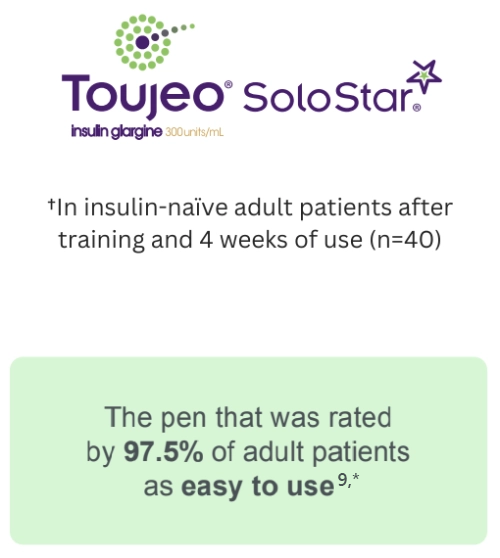
*Study design: This 4-week, multicenter, open-label, single-arm, phase 3b study was conducted in Germany. The primary endpoint was ease of use /ease of learning of the Gla-300 injector pen, as evaluated by the ease of use /ease of learning questionnaire ,18 completed by subjects at baseline, week 1 and week 4.
MAT-IE-2300465 (v3.0)
Date of Preparation: June 2026
Site Entry HCP Disclaimer

Welcome to Sanofi Campus Ireland
This site is intended for Healthcare Professionals in the Republic of Ireland and contains information on Sanofi Ireland medicine, educational resources and more. Please click the appropriate button below. By entering this site, you are confirming that you are a Healthcare Professional in the Republic of Ireland. This site contains promotional information.
MAT-IE-2300185 (v5.0)
Date of Preparation: December 2025