
- Article
- Source: Campus Sanofi
The cascade of Type 2 Inflammation: How do asthma biologic therapies work?
In the era of targeted biologic therapies and precision medicine, guided by biomarkers — how do you know which biologic is right for which patient?
|
A comprehensive representation of Type 2 Inflammation and the role of various cytokines |
Making Type 2 immunology easy to understand with the Type 2 cytokine bucket analogy |
Helping to select the right biologic for the right person |
The Type 2 cytokine bucket analogy explained:
Your patient presents with uncontrolled asthma despite optimized ICS-LABA therapy. Eosinophils are elevated. FeNO possibly high. IgE levels are borderline. They may have comorbid atopic dermatitis or even chronic rhinosinusitis with nasal polyps.
In the era of precision respiratory medicine, where multiple biologics target aspects of the type 2 inflammatory pathway — how do you determine which intervention addresses the root driver of disease across the airway and beyond?
Prof. Brian Lipworth explains his 'type 2 inflammation bucket analogy' — a practical framework for matching the right biologic to the right patient.
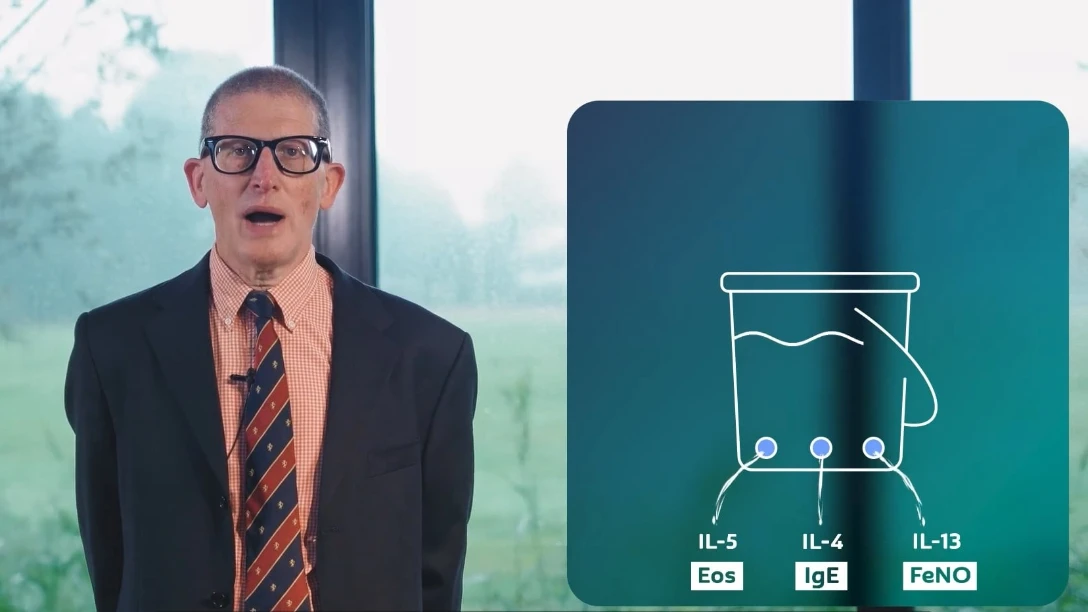
Understanding where to intervene in the type 2 inflammatory cascade is key to optimizing biologic therapy in asthma.
Prof. Lipworth's 'bucket analogy' visualizes the type 2 pathway as a system: the epithelial cytokine 'tap' releases various alarmins including TSLP and IL-33 in response to environmental triggers, allergens, and airway injury. These upstream signals activate type 2 helper cells and innate lymphoid cells, filling the 'mucosal airway bucket' with downstream effector cytokines — IL-4, IL-5, and IL-13 — which drive the clinical manifestations we see: eosinophilic inflammation, elevated FeNO, IgE production, mucus hypersecretion, airway hyperresponsiveness, and remodeling.
Importantly, epithelial cytokines may exert direct pathological effects beyond simply activating the downstream cascade. IgE release itself is mediated by both IL-4 and IL-13, linking allergic sensitization to the broader type 2 response. Of particular clinical significance, IL-13 plays a central role in driving airway remodeling through its effects on subepithelial fibrosis, smooth muscle proliferation, and mucus gland hyperplasia — structural changes that contribute to irreversible lung function decline and treatment resistance.
Abbreviations List:
Eos — Eosinophils; FeNO — Fractional exhaled nitric oxide; IgE — Immunoglobulin E; IL — Interleukin; IL-4 — Interleukin-4; IL-5 — Interleukin-5; IL-13 — Interleukin-13; IL-33 — Interleukin-33; IL-4Rα — Interleukin-4 receptor alpha; IL-5Rα — Interleukin-5 receptor alpha; T2 — Type 2 inflammation; TSLP — Thymic stromal lymphopoietin; ICS-LABA — Inhaled corticosteroid–long-acting beta-2 agonist; CRSwNP — Chronic rhinosinusitis with nasal polyps
.
- Lipworth et al, 2025. Head-To-Head Comparison of Biologic Efficacy in Asthma: What Have We Learned? Allergy, 2025; 80:1226–1241 https://doi.org/10.1111/all.16537
Type 2 inflammation in paediatric asthma
This distinguished presentation by Prof Charl Verwey from the Division of Paediatric Pulmonology at the University of the Witwatersrand and Chris Hani Baragwanath Academic Hospital offers an evidence-based exploration of Type 2 inflammation in paediatric asthma management.
Dupilumab Label Update - August 2025 Launch Webinar
Recent prescribing-information update for a biologic used in severe asthma with a Type 2 inflammatory phenotype.
