
Chronic Rhinosinusitis with Nasal Polyps: The Interplay of Type 2 Inflammation and Smell Loss

Loss of the sense of smell is a major symptom of chronic rhinosinusitis with nasal polyps, affecting up to 90% of patients.1,2 Smell loss, which results in considerable lifestyle and psychological disease burden3, is a key indicator of type 2 inflammation4 and may be the first sign of the disease recurrence.1,2
Type 2 Inflammation and Loss of Smell |
- Loss of the sense of smell is one of the major symptoms of CRSwNP1,2
- It impacts patients QoL3, and may persist even after the surgery4
- Type 2 inflammation may play a role in yielding anosmia/hyposmia5
- It affects ≈90% of CRSwNP patients1
- Anosmia/hyposmia can be an early indicator of disease recurrence1,2
- Degree of type 2 inflammation is correlated with severity of impairment of smell1,2
Smell loss is associated with type 2 inflammation5–9 |
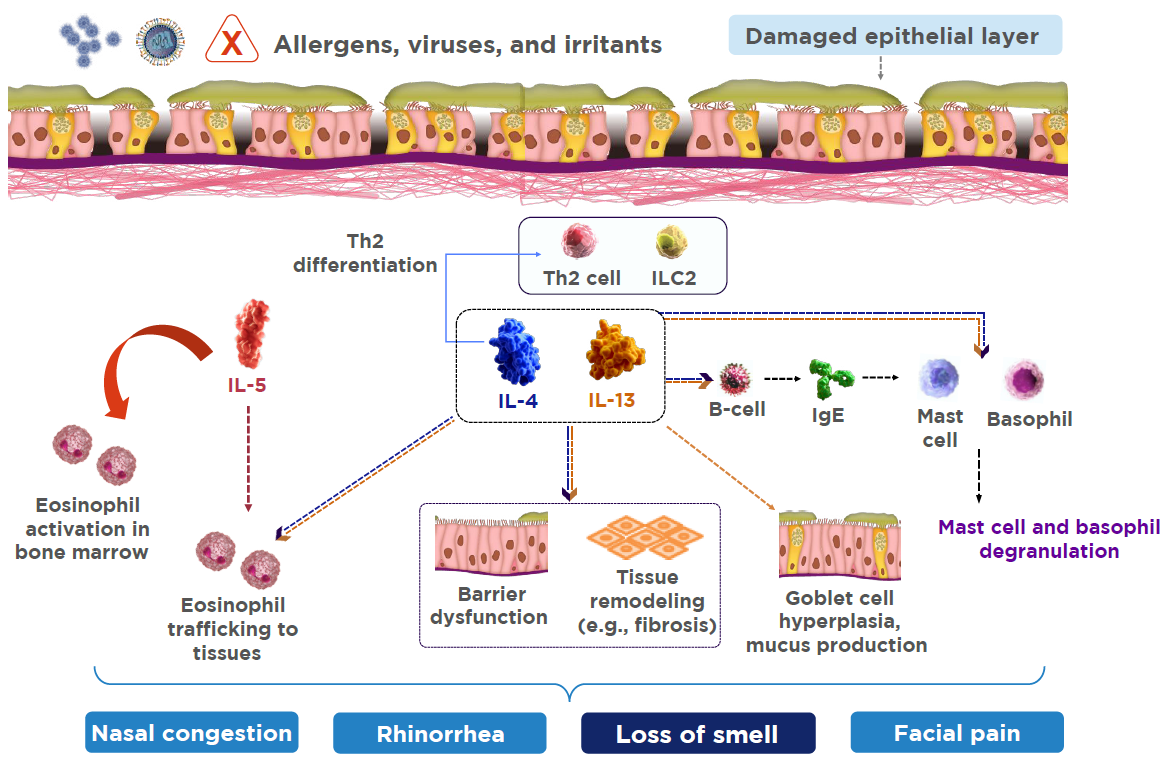
Smell loss represents a major burden for CRSwNP patients1,2 |





Smell improvement as measure of disease control |
Abbreviations
CRS, chronic rhinosinusitis; CRSwNP, chronic rhinosinusitis with nasal polyps; HR-QoL, health-related quality of life; QoL, quality of life.
-
Yan X, et al. Laryngoscope Investig Otolaryngol. 2020;5(6):992-1002;
-
Rouyar A, et al. Allergy. 2019;74(3):549-559;
-
Mullol J, et al. J Allergy Clin Immunol Pract. 2022;10(6):1434-1453.e9;
-
Seys SF, et al. Allergy. 2020;75(11):2867-2878;
-
Dekeyser A, et al. Int J Mol Sci. 2024;25:4460;
-
Bachert C, et al. Front Immunol. 2024;15:1356298;
-
Lee K, et al. Int J Mol Sci. 2021;92:910;
-
Fokkens WJ, et al. Rhinology. 2020;58:1-464;
-
Stevens WW, et al. J Allergy Clin Immunol Pract. 2016;4:565-572;
-
Hopkins C, et al. Otolaryngol Head Neck Surg. 2024;170(4):1173-1182;
-
Patel ZM, et al. Int Forum Allergy Rhinol. 2022;12(4):327-680;
-
Schlosser RJ, et al. Int Forum Allergy Rhinol. 2017;7(1):50-55;
-
Fokkens WJ, et al. Rhinology. 2024;62(3):287-298;
-
Orlandi RR, et al. Int Forum Allergy Rhinol. 2021;11(3):213-739;
-
Rumeau C, et al. Eur Ann Otorhinolaryngol Head Neck Dis. 2016;133(3):203-206;
-
Brumm MC, et al. Neurology. 2023;100(16):e1691-e1701;
-
Mullol J, et al. J Allergy Clin Immunol Pract. 2022;10(4):1086-1095.e5;
-
Doulaptsi M, et al. Clin Transl Allergy. 2018;8:32;
-
Marglani O, et al. J Asthma Allergy. 2023;16:1055-1063;
-
Senna G, et al. Multidiscip Respir Med. 2022;17(1):813;
-
Buchheit KM and Holbrook EH. Chronic rhinosinusitis with nasal polyposis: Management and prognosis. UpToDate. 2023. Available at UpToDate. Last accessed on 28 Aug 2024.
Gerelateerde paginas

SINUS-24/SINUS-52 Demonstrated Reduced Need for Surgery and Oral Corticosteroids — Dupilumab Real-World Data Reinforces with 100% Reduction in the First Year of Treatment in Patients with Severe Uncontrolled CRSwNP
This Italian monocentric study (De Corso et al., 2022) evaluated the real-life effectiveness of dupilumab over the first year of treatment of severe Chronic Rhinosinusitis with Nasal Polyps (CRSwNP) (N=57).2 The results from this real-life observational study reinforces the efficacy of dupilumab demonstrated in the SINUS-24 and SINUS-52 randomized clinical trials and both the study design and results are consistent with the approved SmPC.1,2,3


Bevestig uw status

Bevestig uw status
Sanofi biedt u exclusieve content over onze verschillende therapeutische gebieden op één portal
speciaal voor professionals in de gezondheidszorg, inclusief wetenschappelijk nieuws, een ljst met
evenementen en tools en diensten voor uw dagelijkse praktik.