
Chronic Rhinosinusitis with Nasal Polyps: More Than Just Nasal Obstruction

Chronic rhinosinusitis with nasal polyps (CRSwNP) is a type 2 inflammatory disease associated with frequent recurrence despite effective treatments.1–5
Understanding the role of type 2 inflammation, contributing factors, and treatment strategies, including biologics, can improve management and prevent relapse, potentially offering better outcomes for CRSwNP patients.1–7
Overview of CRSwNP |
- Chronic type 2 inflammation worsens nasal congestion and may cause polyp growth.1,2
- Nasal congestion is a key symptom in CRSwNP, but does not fully capture the multitude of other symptoms such as smell loss.3
- Persistent type 2 inflammation can contribute to nasal polyp recurrence.2–7
Nasal congestion is a manifestation of the underlying disease rather than the disease itself8 |
Inflammatory changes associated with CRSwNP6 |
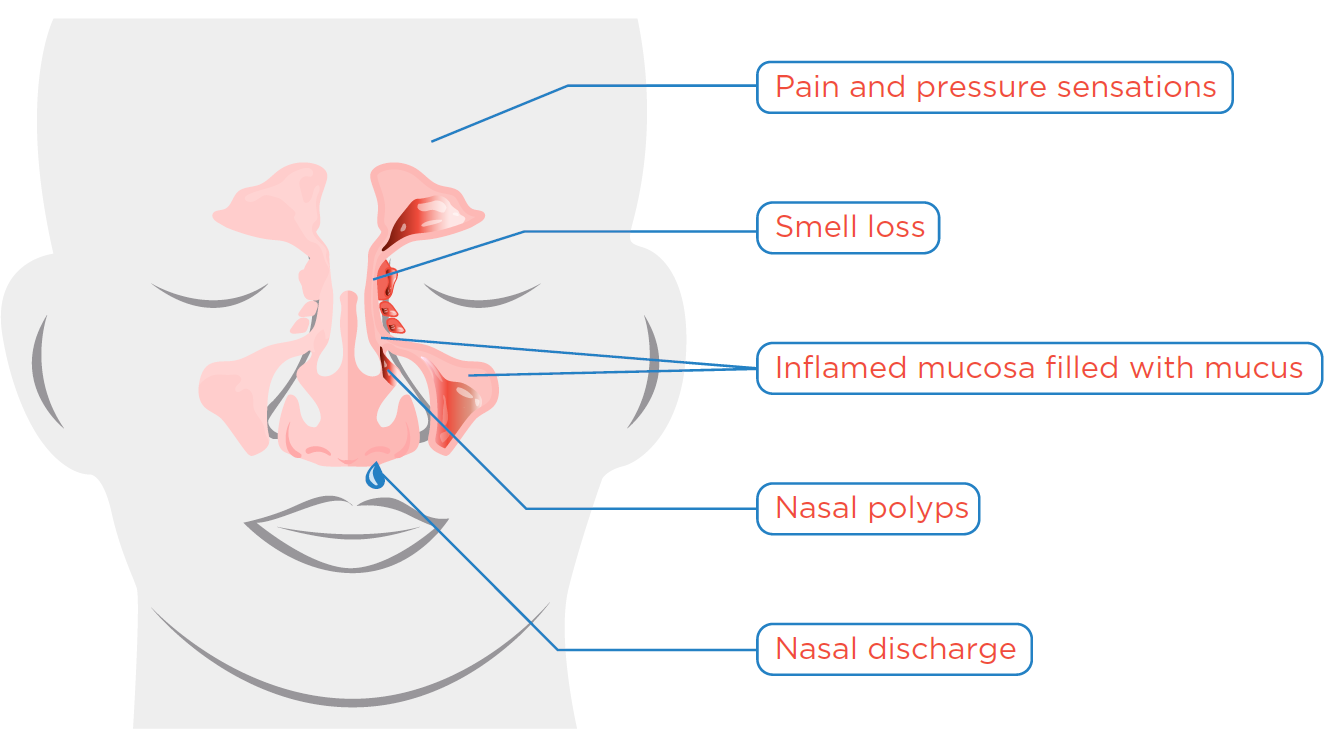
- Nasal polyps can cause significant congestion, obstructing airflow to the olfactory cleft.3,9,10
- Treating congestion without addressing inflammation potentially cause recurring symptoms in CRSwNP such as smell loss and facial pain.4,7,11–13
- Effective management of CRSwNP requires targeting the root cause of type 2 inflammation.3–5,7,9
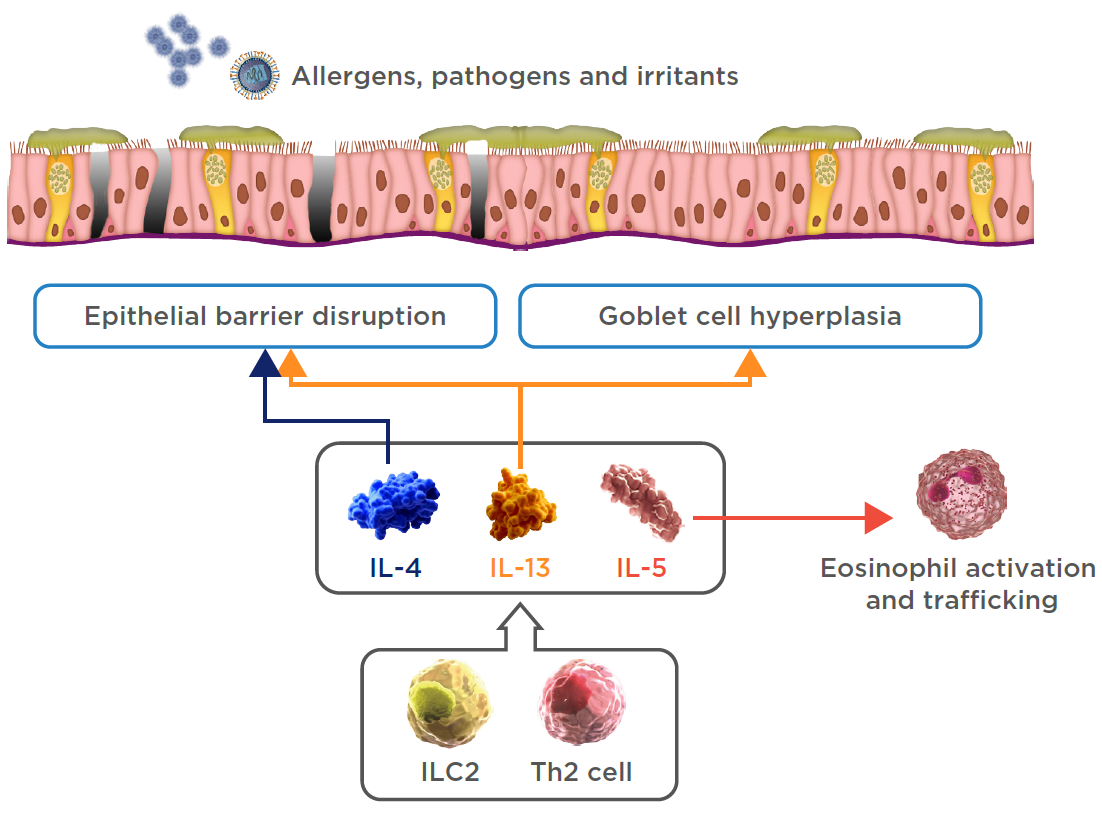
CRSwNP is marked by elevated levels of type 2 inflammatory cytokines (IL-4, IL-5, and IL-13)4,7 |
IL-4 |
IL-13 |
IL-5 |
| Differentiation of Th2 and ILC2 cells | ||
|
Activation of M2 macrophages; B-cell switching and IgE production |
Eosinophil activation in bone marrow | |
| Mast cell activation and trafficking to tissue;
mast cell and basophil degranulation |
||
| Epithelial barrier dysfunction and microbiome imbalance | ||
|
Tissue remodeling (e.g., subepithelial fibrosis) |
||
| Goblet cell hyperplasia and mucus production | ||
| Eosinophil recruitment and trafficking to tissue | ||
Type 2 inflammation leads to nasal congestion, rhinorrhea, loss of smell and facial pain/pressure
In CRSwNP, chronic type 2 inflammation causes abnormal changes in the nasal mucosa1 |
Epithelial remodeling in CRSwNP1,4,5,7 |
Nasal polyp recurrence remains a significant challenge in the management of CRSwNP1,3,6,7,11,12,14 |
Factors associated with the recurrence of nasal polyps |
In CRSwNP, nasal symptoms can have a profound effect on patient’s quality of life (QoL)3,9 |






The chronic nature of CRSwNP requires long-term management strategies to control symptoms and prevent exacerbations.2
Abbreviations
CRSwNP, chronic rhinosinusitis with nasal polyps; IgE, immunoglobulin E; IL, interleukin; ILC2, type 2 innate lymphoid cells; QoL, quality of life; Th2, T-helper 2 cells.
-
Lee K, et al. Int J Mol Sci. 2021;92:910;
-
Gong X, et al. Front Immunol. 2023;14:1238673;
-
Mullol J, et al. J Allergy Clin Immunol Pract. 2022;10(6):1434-1453.e9;
-
Bachert C, et al. Front Immunol. 2024;15:1356298;
-
Stevens WW, et al. J Allergy Clin Immunol Pract. 2016;4:565-572;
-
Schleimer RP. Annu Rev Pathol. 2017;12:331-357;
-
Maspero J, et al. ERJ Open Res. 2022;8(3):00576 20219;
-
Nasal Obstruction. Available at Hopkins Medicine. Accessed on 13 Nov 2024;
-
Hopkins C, et al. Otolaryngol Head Neck Surg. 2024;170(4):1173-1182;
-
Ye P, et al. Front. Surg. 2022;9:870682;
-
Buchheit KM and Holbrook EH. Chronic rhinosinusitis with nasal polyposis: Management and prognosis. UpToDate. 2023. Available at UpToDate. Accessed on 13 Nov 2024;
-
Tsunemi Y, et al. Am J Rhinol Allergy. 2024;38(1):14-22;
-
Yan X, et al. Laryngoscope Investig Otolaryngol. 2020;5(6):992-1002;
-
Fokkens WJ, et al. Rhinology. 2020;58(Suppl 29):1-464.
Gerelateerde paginas

SINUS-24/SINUS-52 Demonstrated Reduced Need for Surgery and Oral Corticosteroids — Dupilumab Real-World Data Reinforces with 100% Reduction in the First Year of Treatment in Patients with Severe Uncontrolled CRSwNP
This Italian monocentric study (De Corso et al., 2022) evaluated the real-life effectiveness of dupilumab over the first year of treatment of severe Chronic Rhinosinusitis with Nasal Polyps (CRSwNP) (N=57).2 The results from this real-life observational study reinforces the efficacy of dupilumab demonstrated in the SINUS-24 and SINUS-52 randomized clinical trials and both the study design and results are consistent with the approved SmPC.1,2,3

Chronic Rhinosinusitis with Nasal Polyps: The Interplay of Type 2 Inflammation and Smell Loss
Bevestig uw status

Bevestig uw status
Sanofi biedt u exclusieve content over onze verschillende therapeutische gebieden op één portal
speciaal voor professionals in de gezondheidszorg, inclusief wetenschappelijk nieuws, een ljst met
evenementen en tools en diensten voor uw dagelijkse praktik.