Reflekter over ny tilgang til KOL
At få en forståelse for type 2 inflammation* kan belyse hvorfor nogle KOL-patienter fortsætter med at få eksacerbationer.1

Læs denne korte brochure om type 2-inflammation* hos patienter med KOL.
At få identificeret og adresseret selve årsagen til type 2-inflammationen* kan være afgørende for at få de ønskede resultater, når man behandler patienter med KOL.
Tænk hvis du kunne identificere høj-risiko patienter?
Ved at få identificeret type 2 inflammationen hos KOL-patienten, vil åbne op for nye muligheder. Kortlæg årsagen til type 2-inflammationen*, EOS er en biomarkør, som kan hjælpe dig identificere hvilke patienter som har en øget risiko for at få nye eksacerbationer.1
Se videoen nedenfor for bedre at forstå forværringer af KOL og bedre identificere risikopatienter.1
Ignite new thinking in COPD - COPD, chronic obstructive pulmonary disease
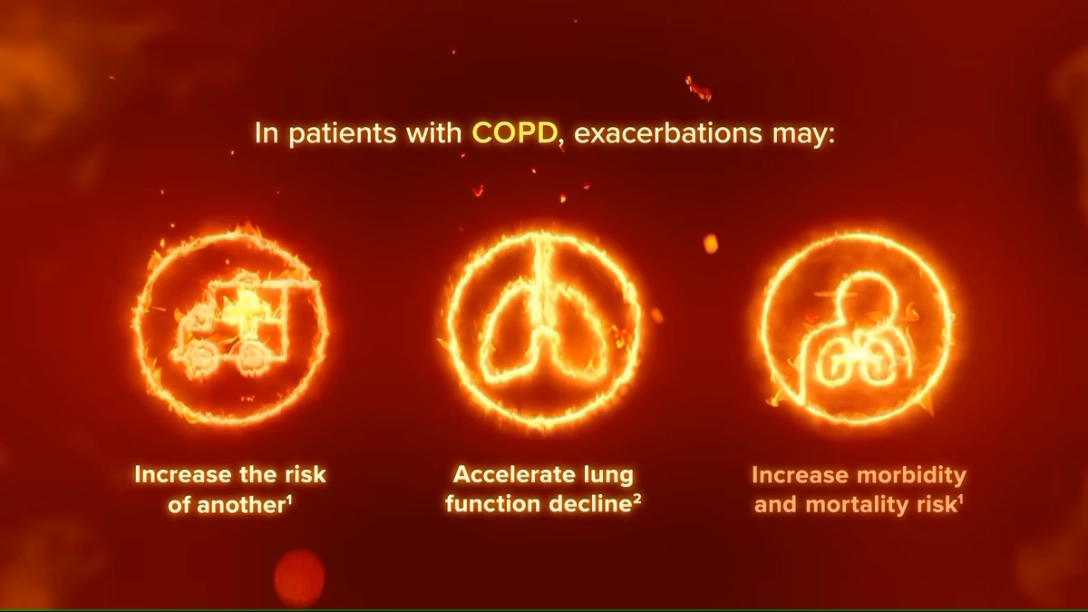
In patients with COPD, exacerbations may :
- Increase the risk of another1
- Accelerate lung function decline2
- Increase morbidity and mortality risk1,3-6
Different types of chronic inflammation have an important role in COPD7-15
Type 2 inflammation and beyond type 2 inflammation
Identifying COPD patients with type 2 inflammation may help determine those at increased risk of exacerbations16
Look for blood eosinophils, a biomarker of COPD with type 2 inflammation17,18,a,b
EOS ≥ 300 cells/ μL à 32% increased risk of COPD exacerbations16a,b
Understanding type 2 inflammation in COPD may shed light on why some patients continue to experience exacerbations
a Results from an observational analysis of 1553 patients with GOLD spirometry grade 2-4 COPD evaluating the relationship between blood eosinophil count and COPD exacerbation risk.
b Stratified analysis confirmed that increased exacerbation risk was driven by subjects with a history of frequent exacerbations, defined as ≥2 exacerbations per year.
-
Suissa S, Dell’Anello S, Ernst P. Long-term natural history of chronic obstructive pulmonary disease: severe exacerbations and mortality. Thorax. 2012;67(11):957-963.
-
Halpin DMG, Decramer M, Celli BR, Mueller A, Metzdorf N, Tashkin DP. Effect of a single exacerbation on decline in lung function in COPD. Respir Med. 2017;128:85-91.
-
Hartl S, Lopez-Campos JL, Pozo-Rodriguez F, et al. Risk of death and readmission of hospital-admitted COPD exacerbations: European COPD Audit. Eur Respir J. 2016;47(1):113-121.
-
Jones SE, Barker RE, Nolan CM, Patel S, Maddocks M, Man WDC. Pulmonary rehabilitation in patients with an acute exacerbation of chronic obstructive pulmonary disease. J Thorac Dis. 2018;10(suppl 12):S1390-S1399.
-
Goërtz YMJ, Spruit MA, Van’t Hul AJ, et al. Fatigue is highly prevalent in patients with COPD and correlates poorly with the degree of airflow limitation. Ther Adv Respir Dis. 2019;13:1753466619878128. doi:10.1177/1753466619878128
-
Miravitlles M, Worth H, Soler Cataluña JJ, et al. Observational study to characterise 24-hour COPD symptoms and their relationship with patient-reported outcomes: results from the ASSESS study. Respir Res. 2014;15(1):122. doi:10.1186/s12931-014-0122-1
-
Cosio Piqueras MG, Cosio MG. Disease of the airways in chronic obstructive pulmonary disease. Eur Respir J. 2001;18(suppl 34):41s-49s.
-
Tajti G, Gesztelyi R, Pak K, et al. Positive correlation of airway resistance and serum asymmetric dimethylarginine level in COPD patients with systemic markers of low-grade inflammation. Int J Chron Obstruct Pulmon Dis. 2017;12:873-884.
-
Higham A, Quinn AM, Cançado JED, Singh D. The pathology of small airways disease in COPD: historical aspects and future directions. Respir Res. 2019;20(1):49. doi:10.1186/s12931-019-1017-y
-
O’Donnell DE, Parker CM. COPD exacerbations. 3: Pathophysiology. Thorax. 2006;61(4):354-361.
-
Calverley PMA. Respiratory failure in chronic obstructive pulmonary disease. Eur Respir J. 2003;22(suppl 47):26s-30s.
-
Roussos C, Koutsoukou A. Respiratory failure. Eur Respir J. 2003;22(suppl 47):3s-14s.
-
Aghapour M, Raee P, Moghaddam SJ, Hiemstra PS, Heijink IH. Airway epithelial barrier dysfunction in chronic obstructive pulmonary disease: role of cigarette smoke exposure. Am J Respir Cell Mol Biol. 2018;58(2):157-169.
-
Brightling CE, Saha S, Hollins F. Interleukin-13: prospects for new treatment. Clin Exp Allergy. 2010;40(1):42-49.
-
Barberá JA, Peinado VI, Santos S. Pulmonary hypertension in chronic obstructive pulmonary disease. Eur Respir J. 2003;21(5):892-905.
-
Yun JH, Lamb A, Chase R, et al; for the COPDGene and ECLIPSE Investigators. Blood eosinophil count thresholds and exacerbations in patients with chronic obstructive pulmonary disease. J Allergy Clin Immunol. 2018;141(6):2037-2047.e10.
-
Halpin DMG, Dransfield MT, Han MK, et al. The effect of exacerbation history on outcomes in the IMPACT trial. Eur Respir J. 2020;55:1901921. doi:10.1183/13993003.01921-2019
-
Global Initiative for Chronic Obstructive Lung Disease. Global strategy for the diagnosis, management, and prevention of chronic obstructive pulmonary disease (2023 report). Accessed [June 2, 2023]. https://goldcopd.org/2023-gold-report-2/
* Type 2 inflammation hos KOL er defineret ved forhøjet biomarkør. (Eosinofile celler i blodet >300 µL eller >2% eller eosinofile celler i sputum på > 3%)
Referencer
-
Yun JH, Lamb A, Chase R, et al; for the COPDGene and ECLIPSE Investigators. Blood eosinophil count thresholds and exacerbations in patients with chronic obstructive pulmonary disease. J Allergy Clin Immunol. 2018;141(6):2037-2047.e10.