
- Article
- Source: Campus Sanofi
The Biology and Transmission of Neisseria Meningitidis
Biology and transmission dynamics of Neisseria meningitidis relevant to disease risk and prevention strategy.
.2023-12-04-08-14-49.svg)
Meningococcal infections
Cause: bacterium Neisseria meningitidis1
- An aerobic, gram-negative, oxidase-positive, diplococcus bacterium1
- Exclusively human pathogen1
- Obligate commensal organism-nasopharynx 2
- Can be capsulated or non-capsulated1
- 12 known capsular serogroups based on the biochemical structure of the capsule1
- Most meningococcal disease is caused by N. meningitidis serogroups:1

- Invasive disease is dependent on the virulence of the strain and various host characteristics2

- McNamara LA, Pollard AJ, Harrison LH. Meningococcal Capsular Group A, C, W, and Y Conjugate Vaccines. In: Orenstein W, Offit P, Edwards KM, Plotkin S, editors. Plotkin's Vaccines. 8th ed. Elsevier; 2023. p. 664-689.e12. ISBN 9780323790581.
- Van Deuren M, Brandtzaeg P, van der Meer JW. Update on meningococcal disease with emphasis on pathogenesis and clinical management. Clinical microbiology reviews. 2000 Jan 1;13(1):144-66.
IMD Carriage
N. meningitidis carriage is necessary but not always predictive of IMD1-3
European meta-analysis of 89 studies in 28 countries3
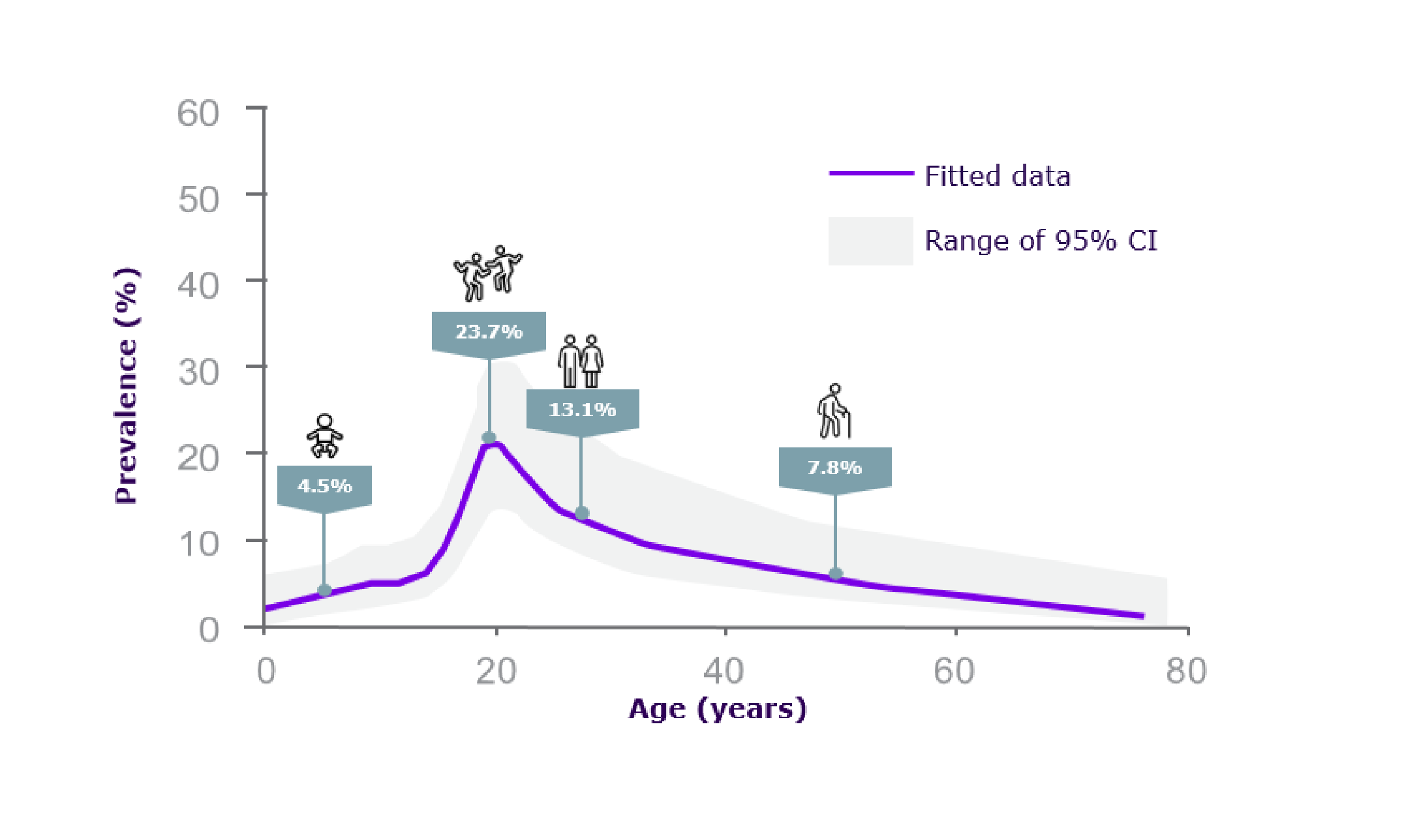
- Between 5% and 20% of the general population are asymptomatic carriers at any given time1-3
The age-related trend in the carriage is nonlinear:
- Infants from 4,5%, increasing to 7,7% in 10-year-olds, and peaking at 23,7% in 19-year-olds, subsequently decreasing in adulthood to 7,85% at 50 years of age3
Adapted from Christensen H, et al. Lancet Infect Dis 20103
CI, confidence interval; IMD, invasive meningococcal disease.
- Rouphael NG et al., Methods Mol Biol. 2012;799:1-20;
- European Centre for Disease Prevention and Control. Factsheet about meningococcal disease. https://ecdc.europa.eu/en/meningococcal-disease/factsheet. Updated 28 November 2023 [Accessed April 2025];
- Christensen H et al., Lancet Infect Dis. 2010;10(12):853-861.
Neisseria meningitidis spreads through close contact with respiratory or throat secretions, such as through coughing, kissing or prolonged close contact, rather than through casual or airborne transmission. This transmission pattern explains why household members and close contacts of a confirmed case are considered at elevated risk. Asymptomatic nasopharyngeal carriage is common in the general population and represents the primary reservoir for transmission. Public health response following a confirmed case typically focuses on identifying and managing close contacts.
South African surveillance data through the GERMS-SA programme has identified serogroups B and W as the most common causes of invasive meningococcal disease, followed by C and Y. This serogroup distribution differs from patterns seen in some other regions, which has implications for locally relevant vaccination strategy. Serogroup distribution can also shift over time, making ongoing surveillance important. Understanding local serogroup patterns supports more informed vaccination and prevention discussions.
Asymptomatic nasopharyngeal carriage is relatively common and represents the main source from which invasive disease occasionally develops and spreads to others. Most carriers never develop invasive disease themselves, but they can transmit the organism to others who may be more susceptible. This carriage dynamic underlies why close contacts of a confirmed case are considered for prophylactic antibiotic treatment. Understanding this transmission reservoir supports appropriate public health and clinical response following case identification.
Confirm that you are a healthcare professional to continue reading.
Click login to continue

Age and Serogroup Patterns: IMD in South Africa
Comprehensive analysis of Invasive Meningococcal Disease (IMD) patterns in South Africa, featuring GERMS-SA surveillance data from 2018-2024. Highlights age-specific incidence rates, with detailed focus on infant vulnerability (1.6 per 100,000) and adolescent/young adult peaks. Includes serogroup distribution trends across the country.

Age-Related Risk Factors for IMD: From Infants to Elderly
Comprehensive overview of age-specific risk factors for Invasive Meningococcal Disease (IMD), detailing vulnerability patterns across different life stages. Features specific risks for infants, adolescents, and elderly populations, including the impact of maternal antibody decline, nasopharyngeal colonization, and immunosenescence in older adults.
Protecting Pilgrims: Meningococcal Disease Risk Factors During Mass Gatherings
Comprehensive analysis of meningococcal disease risk factors during mass religious gatherings, with focus on the Hajj pilgrimage. Details environmental challenges, demographic vulnerabilities, and transmission dynamics among pilgrims, local residents, and healthcare workers in Mecca, with emphasis on crowded conditions and N. meningitidis carriage rates.