
- Article
- Source: Campus Sanofi
Aumento de peso e insulinoterapia: impacto clínico en diabetes
El aumento de peso asociado al inicio o la intensificación de la insulinoterapia es una preocupación frecuente entre médicos y pacientes, y puede convertirse en una barrera para la adherencia terapéutica. Comprender los mecanismos fisiopatológicos del incremento ponderal relacionado con la insulina y las estrategias para minimizarlo es esencial para optimizar el manejo del paciente diabético. Este contenido revisa la evidencia disponible y las recomendaciones prácticas para abordar este aspecto desde la consulta. Explore los recursos disponibles para un manejo más integral de la insulinoterapia.
La insulina favorece el almacenamiento de glucosa como glucógeno y grasa, reduce la lipólisis y puede inducir mayor ingesta calórica por hipoglucemia. El incremento ponderal es más pronunciado al inicio del tratamiento o durante la intensificación, especialmente en pacientes con control glucémico previo deficiente que corrigen una glucosuria significativa.
Las estrategias incluyen la optimización del plan alimentario con apoyo nutricional, la selección de esquemas insulínicos con menor riesgo hipoglucémico, la combinación con agentes con efecto neutro o reductor de peso cuando sea pertinente, y la promoción de actividad física regular. La educación del paciente sobre ajuste de dosis y manejo de hipoglucemias también contribuye a reducir la ganancia ponderal.

Introducción a la insulinoterapia y el aumento de peso
El inicio oportuno de la insulina es importante para el control glucémico. Sin embargo, algunos pacientes con diabetes tipo 2 pueden mostrarse reticentes a comenzar debido a preocupaciones sobre el posible aumento de peso1. Las estrategias y consejos prácticos en este artículo pueden ayudar en las conversaciones para abordar la reticencia de tus pacientes sobre el inicio de la insulina debido a sus preocupaciones sobre el aumento de peso.
Entendiendo las preocupaciones de los pacientes asociadas a la insulina y a la ganancia de peso
El aumento de peso es una preocupación válida para los pacientes que consideran la terapia con insulina. Las investigaciones demuestran que el aumento de peso asociado a la insulina es multifactorial, e involucra la reducción de la glucosuria, la ingesta preventiva para evitar la hipoglucemia y los efectos anabólicos del propio fármaco. Además, el aumento de peso es proporcional al grado de hiperglucemia inicial, lo que sugiere que este incremento es más prominente cuando la insulina basal se introduce tardíamente1. Sin embargo, las formulaciones de insulina de segunda generación y las estrategias de manejo individualizadas, pueden mitigar estos efectos. La comunicación médico-paciente, en el momento del diagnóstico, puede mejorar la comprensión y los resultados2. Reconocer y abordar las preocupaciones abiertamente y utilizar un lenguaje de apoyo, sin juicios de valor3, puede ayudar a que los pacientes perciban de manera positiva el tratamiento con insulina. También es importante destacar que comenzar el tratamiento con insulina no debe verse como un fracaso personal, sino como una herramienta efectiva para manejar una condición progresiva.
Insulinas de segunda generación y cambios en el peso en pacientes con diabetes tipo 2
Las insulinas basales de segunda generación representan un avance en el tratamiento de la diabetes, ofreciendo diversos beneficios que pueden ayudar a abordar las preocupaciones sobre el aumento de peso.
- Estos análogos de insulina proporcionan un perfil de acción más prolongado y estable en comparación con las insulinas de acción prolongada de primera generación, resultando en un control más consistente de la glucemia4
- Su perfil farmacocinético puede estar asociado con un menor riesgo de hipoglucemia, lo que potencialmente puede reducir la ingesta preventiva1,5
Consideraciones prácticas para el control del peso en pacientes en tratamiento con insulina
Educación del paciente en tratamiento con insulina

Considera estos enfoques basados en la evidencia6,7:
Iniciando la conversación
La calidad de la comunicación médico-paciente influye en los resultados del tratamiento en la atención de la diabetes
- Comienza reconociendo las preocupaciones de tu paciente2,3:

- El lenguaje centrado en la persona y libre de juicios mejora la participación del paciente y los resultados en el tratamiento de la diabetes3
Proporcionar educación
- La educación intensiva del paciente mejora el control glucémico en comparación con la educación convencional7
- Educa a los pacientes sobre las herramientas de salud que pueden ser de apoyo en las consultas con el profesional sanitario8
- Enseña a los pacientes cómo interpretar los datos de su monitorización de la glucosa para mejorar el autocontrol9
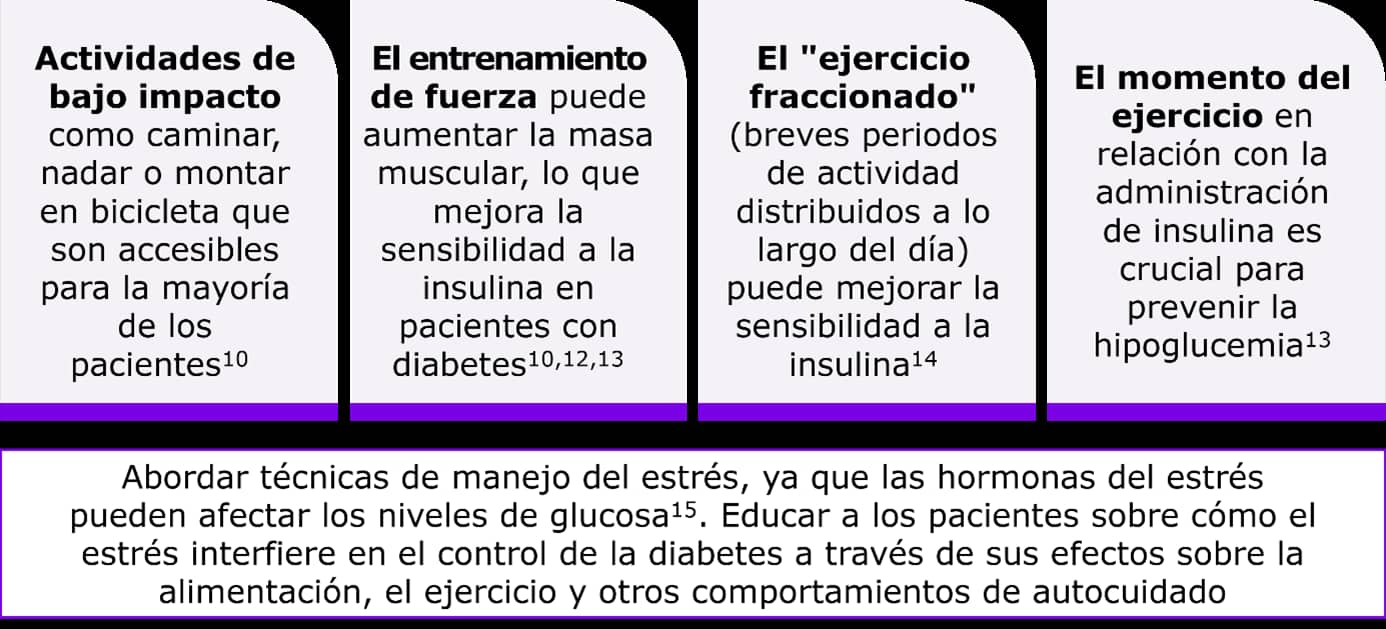
Actividad física para el control del peso

Anima a los pacientes a seguir estas recomendaciones basadas en evidencia:
Planificación nutricional y alimentación en diabetes

Anima a los pacientes a seguir estas recomendaciones basadas en evidencia:
- Recomienda planes de alimentación individualizados que consideren preferencias, estilo de vida y contexto cultural17
- Explica cómo la titulación adecuada de insulina permite ajustes basados en los niveles de actividad y la ingesta de alimentos16
- Comparte información sobre el método del plato que sirve como una guía visual simple para el control de porciones y comidas equilibradas18
- Explica que mantener una consistencia en el horario y la composición de las comidas ayuda a estabilizar los niveles de glucosa17
- Comenta sobre el índice glucémico y su relevancia para la dosificación de insulina y el manejo de la glucemia 17
Entrevistas motivacionales y apoyo psicológico para la diabetes

Considera estos enfoques, basados en la evidencia, para mejorar los resultados del paciente:
- Implementa técnicas de entrevista motivacional para aumentar la participación del paciente 19
- Personaliza las estrategias para conectar con el estilo de vida y objetivos específicos del paciente6
- Crea un espacio para que los pacientes expresen sus miedos sobre la insulina o el aumento de peso3
Beneficios del inicio oportuno de la insulina en la diabetes tipo 2
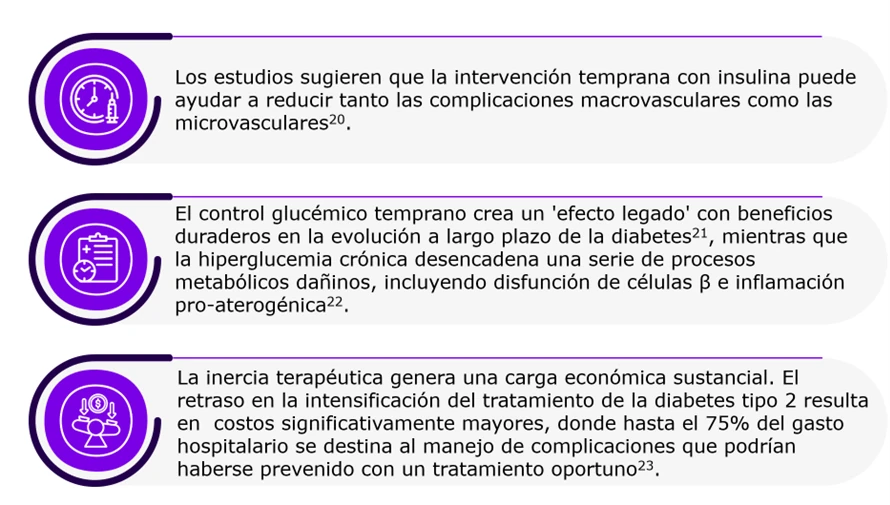
Cuando los pacientes comprenden estos hechos, pueden estar más dispuestos a considerar los beneficios de la insulinoterapia a pesar de las preocupaciones sobre el peso.
Conclusión: Control efectivo del peso para pacientes en insulinoterapia
Al abordar directamente las preocupaciones sobre el aumento de peso, asociado con la insulinoterapia, y proporcionar estrategias basadas en la evidencia, puedes ayudar a los pacientes a superar su reticencia para comenzar su tratamiento con insulina. Siguiendo un enfoque integrado, combinando una insulina con planificación alimentaria individualizada y actividad física adecuada, se logra una mejora el control de la diabetes sin un aumento significativo de peso.
Puntos clave
1. Educar a los pacientes, sobre el tratamiento con insulina, representa un paso positivo hacia una mejor comprensión de los cambios posibles en el peso
2. Puedes apoyar a tus pacientes proporcionándoles acciones concretas, que sean fácilmente implementables, para ayudarles con su tratamiento y control de peso a largo plazo.
Debes ser un profesional de la salud para continuar leyendo este contenido.
¿Eres un profesional de la salud?
Regístrate para obtener acceso exclusivo a las últimas noticias sobre avances científicos y a recursos que mejoren la vida de tus pacientes.
Iniciar sesión para profesionales de la salud
* La contraseña debe tener un mínimo de 8 caracteres e incluir al menos 1 letra mayúscula, 1 letra minúscula y 1 número.
HCP Verification Required
Reenviar éxito!
Por favor revise su correo electrónico para verificar el correo electrónico.
Unauthorized login
Bienvenido al campus sanofi
¡Éxito!
Se ha enviado un enlace de correo electrónico de verificación a su bandeja de entrada. Por favor, revise su bandeja de entrada ahora.
Referencias
- Russell-Jones D, Khan R. Insulin-associated weight gain in diabetes—causes, effects and coping strategies. Diabetes Obes Metab. 2007;9(6):799-812.
- Polonsky WH, Capehorn M, Belton A, et al. Physician-patient communication at diagnosis of type 2 diabetes and its links to patient outcomes: New results from the global IntroDia study. Diabetes Res Clin Pract. 2017;127:265-274.
- Dickinson JK, et al. The use of language in diabetes care and education. Diabetes Care. 2017;40(12):1790-1799.
- Bolli GB, Home PD, Porcellati F, et al. The Modern Role of Basal Insulin in Advancing Therapy in People With Type 2 Diabetes. Diabetes Care. 2025;48(5):671-681.
- Heller S, Buse J, Fisher M, et al. Insulin degludec, an ultra-long acting basal insulin, versus insulin glargine in basal-bolus treatment with mealtime insulin as part in type 1 diabetes (BEGIN Basal-Bolus Type 1): a phase 3, randomised, open-label, treat-to-target non-inferiority trial. Lancet. 2012;379(9825):1489-1497.
- Young-Hyman D, de Groot M, Hill-Briggs F, et al. Psychosocial Care for People With Diabetes: A Position Statement of the American Diabetes Association. Diabetes Care. 2016;39(12):2126-2140.
- Essien O, Otu A, Umoh V, et al. Intensive Patient Education Improves Glycaemic Control in Diabetes Compared to Conventional Education: A Randomised Controlled Trial in a Nigerian Tertiary Care Hospital. PLoS ONE. 2017;12(1):e0168835.
- Mubeen F, Low Wang CC, Al Maradni A, Shivaswamy V, Sadhu AR. Digital Health and Shared Decision-Making in Diabetes Care – A Survey Initiative in Patients and Clinicians. Endocr Pract. 2023;29(7):538-545. doi:10.1016/j.eprac.2023.04.012
- Battelino T, Danne T, Bergenstal RM, et al. Clinical Targets for Continuous Glucose Monitoring Data Interpretation: Recommendations From the International Consensus on Time in Range. Diabetes Care. 2019;42(8):1593-1603.
- Colberg SR, Sigal RJ, Yardley JE, et al. Physical Activity/Exercise and Diabetes: A Position Statement of the American Diabetes Association. Diabetes Care. 2016;39(11):2065-2079.
- Umpierre D, Ribeiro PA, Kramer CK, et al. Physical activity advice only or structured exercise training and association with HbA1c levels in type 2 diabetes: a systematic review and meta-analysis. JAMA. 2011;305(17):1790-1799.
- Boulé NG, Haddad E, Kenny GP, Wells GA, Sigal RJ. Effects of exercise on glycemic control and body mass in type 2 diabetes mellitus: a meta-analysis of controlled clinical trials. JAMA. 2001;286(10):1218-1227.
- Sigal RJ, Kenny GP, Wasserman DH, Castaneda-Sceppa C, White RD. Physical activity/exercise and type 2 diabetes: a consensus statement from the American Diabetes Association. Diabetes Care. 2006;29(6):1433-1438.
- Francois ME, Baldi JC, Manning PJ, et al. 'Exercise snacks' before meals: a novel strategy to improve glycaemic control in individuals with insulin resistance. Diabetologia. 2014;57(7):1437-1445.
- Surwit RS, van Tilburg MAL, Zucker N, et al. Stress management improves long-term glycemic control in type 2 diabetes. Diabetes Care. 2002;25(1):30-34.
- Kuritzky L, Reid TS, Wysham CH. Practical Guidance on Effective Basal Insulin Titration for Primary Care Providers. Clin Diabetes. 2019;37(4):368-376.
- Evert AB, Dennison M, Gardner CD, et al. Nutrition Therapy for Adults With Diabetes or Prediabetes: A Consensus Report. Diabetes Care. 2019;42(5):731-754.
- Camelon KM, Hådell K, Jämsén PT, et al. The Plate Model: A visual method of teaching meal planning. J Am Diet Assoc. 1998;98(10):1155-1158.
- Dellasega C, Añel-Tiangco RM, Gabbay RA. How patients with type 2 diabetes mellitus respond to motivational interviewing. Diabetes Res Clin Pract. 2012;95(1):37-41.
- Holman RR, et al. 10-year follow-up of intensive glucose control in type 2 diabetes. N Engl J Med. 2008;359:1577–1589.
- Laiteerapong N, et al. The Legacy Effect in Type 2 Diabetes: Impact of Early Glycemic Control on Future Complications (The Diabetes & Aging Study). Diabetes Care. 2019;42:416–426.
- Hanefeld M, et al. Rationale for Timely Insulin Therapy in Type 2 Diabetes Within the Framework of Individualised Treatment: 2020 Update. Diabetes Ther. 2020;11:1645–1666.
- PwC, EFPIA. Revealing policy barriers in diabetes care: how we can improve outcomes. 2023 May [consultado el 18 de junio de 2025]. Available from: Disponible en: https://www.efpia.eu/media/676746/revealing-policy-barriers-in-diabetes-care-how-we-can-improve-outcomes.pdf

Insulina basal de segunda generación en diabetes tipo 2: cómo alcanzar los objetivos terapéuticos en diversas poblaciones de pacientes
Explora el papel de la insulina basal de segunda generación en diabetes tipo 2 y estrategias para alcanzar objetivos terapéuticos en diversas poblaciones de pacientes.
.png/jcr:content/MAT-MX-2502858%20THUMBNAIL%20CASO%20PR%C3%81CTICO%202%20DELIVERT%20(1).png)
Manejo Diabetes: DELIVER-T Caso 2
En este apartado del conversatorio, los especialistas analizan los desenlaces secundarios del estudio Deliver-T, poniendo el foco en el logro de objetivos glucémicos y los factores que influyen en su alcance. A través del intercambio clínico, se reflexiona sobre la importancia de una titulación adecuada, el tiempo de seguimiento, la educación terapéutica y la definición conjunta de metas con el paciente. Asimismo, se abordan consideraciones prácticas como la individualización del tratamiento, la prevención de la sobrebasalización, el rol del estilo de vida y el apoyo del monitoreo continuo de glucosa como herramientas para optimizar el manejo de la diabetes tipo 2 en la práctica diaria.

DELIVER-T: Conversatorio Clínico
En este conversatorio con líderes de opinión de Latinoamérica, se genera un espacio de análisis y reflexión clínica en torno a la intensificación del tratamiento en personas con diabetes tipo 2 que permanecen fuera de objetivos terapéuticos. A partir del estudio Deliver-T, los especialistas comparten evidencia del mundo real y su experiencia en la práctica clínica, abordando criterios de decisión, consideraciones de seguridad y el impacto del manejo integral en el control metabólico y la calidad de vida del paciente, con un enfoque aplicable al día a día del profesional de la salud.