Sanofi at ESC Congress 2026 | ASCVD & LDL-C Management
Discover how you can help change the trajectory of ASCVD.

Redefining the future of ASCVD care at the ESC Congress 2026
Collaboration between healthcare partners is crucial to help improve the condition of ASCVD patients and is a shared priority across the cardiovascular community. At Sanofi, we are excited to have the opportunity to cooperate with healthcare professionals and the European Society of Cardiology (ESC) in Munich for the ESC Congress 2026.
Similar to previous years, we had a strong presence and were active participants at the 2026 congress. We presented a comprehensive programme – featuring our symposium and new scientific data, real world evidence data – all designed to explore the latest evidence in ASCVD management and to advance clinical practice. Whether you were with us at the congress or are catching up now, we are pleased to share the key highlights and resources from our programme with you.
Explore our symposium and presentations below.

Scientific symposium
“Looking Back to Move Forward: Changing The Trajectory of ASCVD Through Early Optimization of LDL-C Care” |

Prof. Deepak L. Bhatt
Director, Mount Sinai Fuster Heart Hospital Dr. Valentin Fuster Professor of Cardiovascular Medicine Icahn School of Medicine, New York, USA

Prof. Sigrun Halvorsen
Professor of Cardiology, Department of Cardiology, University Hospital Ullevål, Oslo, Norway

Prof. Ulrich Laufs
Professor of Cardiology Department of Cardiology Universitätsklinikum Leipzig, Leipzig, Germany

Prof. Kausik K. Ray
Professor of Public Health, Cardiology &Preventive Medicine, ImperialCollege London, UK
Watch the video below for the post-symposium highlights from one of our speakers, Professor Ulrich Laufs
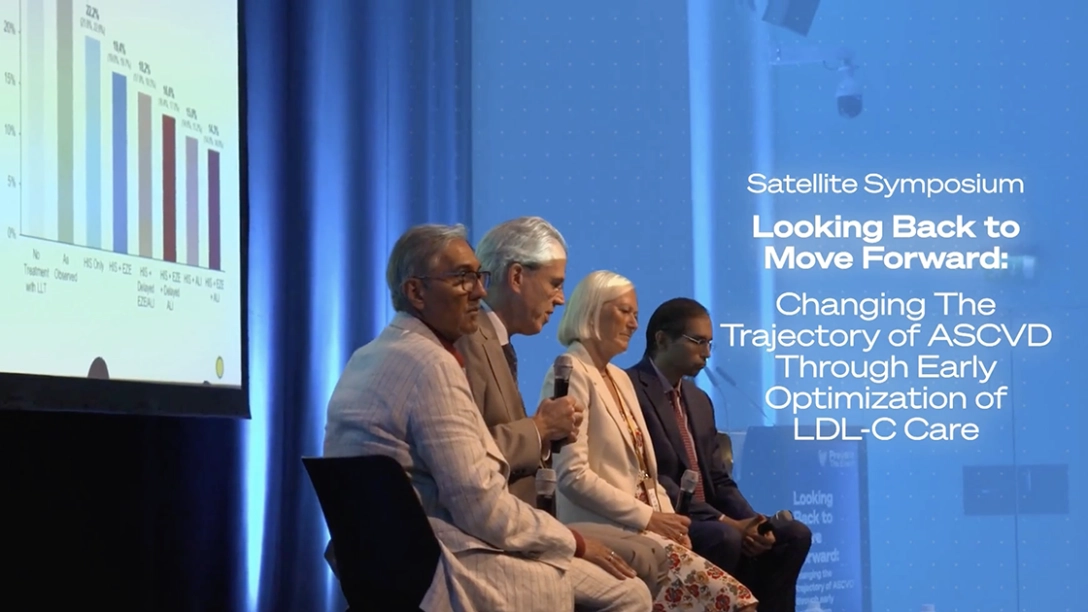
This interactive symposium discussed how early identification of high-risk patients, and intensive lipid management can help change the trajectory of ASCVD.
Led by global experts, the session explored the latest data in ASCVD management and its impact on lipid-lowering treatment decisions. Through a novel reverse case study, interactive polling and actionable insights, the experts shared fresh perspectives that may be useful for your clinical practice.
Here’s a summary of what was discussed

|
ASCVD remains the leading cause of death worldwide,1 yet more than 50% of all CV events are preventable with timely risk factor management2 |

|
New data showed that early and intensive lipid-lowering with highly potent treatments, such as PCSK9i mAbs, were associated with CV risk reduction across the ASCVD continuum3,4 |

|
|

|
|

|
In ASCVD patients, it is never too early to reduce CV risk by further lowering LDL-C with a PCSK9i3 |
Looking for more data on CV risk reduction in ASCVD patients without prior ischaemic events?
Download the OPTIMUS-CLASS graphical abstract
PRALUENT at ESC Congress 2026
We were delighted to play our part at ESC Congress 2026 and contribute to ongoing efforts to changing the trajectory of ASCVD.
We look forward to continuing in our journey to help improve ASCVD outcomes, together.
ODYSSEY OUTCOMES: A multicentre, randomised, double-blind, placebo-controlled phase 3 study. Adult patients with a recent MI or UA, and on high-intensity statin (40 mg or 80 mg atorvastatin, or 20 mg or 40 mg rosuvastatin, or maximally tolerated dose of one of these agents) +/- other lipid-lowering therapy, but not at predefined target LDL-C, were enrolled. Patients were randomly assigned to subcutaneous PRALUENT 75 mg (n=9,462) or matching placebo (n=9,462) Q2W. The PRALUENT dose was adjusted under blinded conditions to target an LDL-C level of 25–50 mg/dL (0.6–1.3 mmol/L).5,6
OPTIMUS-CLASS: retrospective real-world database review aiming to evaluate the impact of PCSK9i mAbs on the primary endpoint (composite of nonfatal MI, nonfatal IS, or all-cause mortality) vs. no PCSK9i (no PCSK9i mAbs [alirocumab or evolocumab] or PCSK9i siRNA [inclisiran]). The study population consisted of patients with ASCVD but without prior ischaemic events. Patients who initiated PCSK9i mAbs (n=6,545) were identified in the US Optum Research Database and propensity score matching was implemented to select a comparable group without any PCSK9i use (n=13,125). Parametric G-formula was used to estimate the expected event rate curves over time for the primary endpoint.4
PRALUENT is indicated for:6
Primary hypercholesterolaemia and mixed dyslipidaemia
PRALUENT is indicated in adults with primary hypercholesterolaemia (heterozygous familial and nonfamilial) or mixed dyslipidaemia, and in paediatric patients 8 years of age and older with heterozygous familial hypercholesterolaemia (HeFH) as an adjunct to diet:
– in combination with a statin or statin with other lipid lowering therapies in patients unable to reach LDL-C goals with the maximum tolerated dose of a statin or,
– alone or in combination with other lipid-lowering therapies in patients who are statin-intolerant, or for whom a statin is contraindicated.
Established atherosclerotic cardiovascular disease
PRALUENT is indicated in adults with established atherosclerotic cardiovascular disease to reduce cardiovascular risk by lowering
LDL-C levels, as an adjunct to correction of other risk factors:
– in combination with the maximum tolerated dose of a statin with or without other lipid-lowering therapies or,
– alone or in combination with other lipid-lowering therapies in patients who are statin-intolerant, or for whom a statin is contraindicated.
Abbreviations
ACS = acute coronary syndrome; ARR = absolute risk reduction; ASCVD = atherosclerotic cardiovascular disease; CV = cardiovascular; CVOT = cardiovascular outcomes trial; ESC = European Society of Cardiology; HeFH = heterozygous familial hypercholesterolaemia; IS = ischaemic stroke; LDL-C = low-density lipoprotein cholesterol; LLT = lipid-lowering therapy; mAb = monoclonal antibody; MI = myocardial infarction; PCSK9i = proprotein convertase subtilisin/kexin type 9 inhibitor; Q2W = every 2 weeks; RRR = relative risk reduction; siRNA = small interfering ribonucleic acid; UA = unstable angina; US = United States.
Referanser
-
Ray KK, Ference BA, Séverin T, et al. World Heart Federation Cholesterol Roadmap 2022. Glob Heart. 2022;17(1):75.
-
Stark BA, DeCleene NK, Desai EC, et al. Global, regional, and national burden of cardiovascular diseases and risk factors in 204 countries and territories, 1990–2023. J Am Coll Cardiol 2025;86(22):2167–243.
-
Sinning D and Landmesser U. PCSK9 inhibition in patients without previous cardiovascular events but at high risk: the earlier the better. Eur Heart J. 2026;ehag456.
-
Bhatt DL, Perrone Filardi P, Khan I, et al. PCSK9 inhibitor treatment and outcomes in patients with atherosclerotic cardiovascular disease but without prior ischaemic events: an observational study. Eur Heart J. 2026;ehag176.
-
Schwartz GG, Steg PG, Szarek M, et al. Alirocumab and cardiovascular outcomes after acute coronary syndrome. N Engl J Med. 2018;379(22):2097–2107.
-
PRALUENT (alirocumab) Summary of Product Characteristics. Paris, France: sanofi-aventis groupe;
NAME OF THE MEDICINAL PRODUCT: Praluent 75 mg, 150 mg or 300 mg solution for injection in pre-filled pen. QUALITATIVE AND QUANTITATIVE COMPOSITION: Each single-use pre-filled pen contains 75 mg alirocumab in 1 ml solution, 150 mg alirocumab in 1 ml solution or 300 mg in 2 ml solution. THERAPEUTIC INDICATIONS: Primary hypercholesterolaemia and mixed dyslipidaemia Praluent is indicated in adults with primary hypercholesterolaemia (heterozygous familial and non-familial) or mixed dyslipidaemia and in paediatric patients 8 years of age and older with heterozygous familial hypercholesterolaemia (HeFH) as an adjunct to diet: - in combination with a statin or statin with other lipid lowering therapies in patients unable to reach LDL-C goals with the maximum tolerated dose of a statin or,- alone or in combination with other lipid-lowering therapies in patients who are statin-intolerant, or for whom a statin is contraindicated. Established atherosclerotic cardiovascular disease Praluent is indicated in adults with established atherosclerotic cardiovascular disease to reduce cardiovascular risk by lowering LDL-C levels, as an adjunct to correction of other risk factors: - in combination with the maximum tolerated dose of a statin with or without other lipid-lowering therapies or, - alone or in combination with other lipid-lowering therapies in patients who are statin-intolerant, or for whom a statin is contraindicated. POSOLOGY AND METHOD OF ADMINISTRATION: Prior to initiating alirocumab secondary causes of hyperlipidaemia or mixed dyslipidaemia (e.g., nephrotic syndrome, hypothyroidism) should be excluded. The recommended alirocumab doses are 75 mg once every 2 weeks, 150 mg once every 2 weeks, 300 mg once every 4 weeks (monthly), administered subcutaneously. All doses may be used for initiation of treatment. The dose of alirocumab can be individualized based on patient characteristics such as baseline LDL-C level, goal of therapy, and response. Lipid levels can be assessed 4 to 8 weeks after treatment initiation or titration, and dose adjusted accordingly (up-titration or down-titration). Intense LDL-C reduction is expected with alirocumab 150 mg once every 2 weeks and 300 mg once every 4 weeks (monthly), where 150 mg once every 2 weeks is the maximum dose. If a dose is missed, the patient should administer the injection as soon as possible and thereafter resume treatment on the original schedule. No dose adjustment is needed for elderly patients, or patients with mild or moderate hepatic or renal impairment, in patients based on weight. Alirocumab has not been studied in paediatric patients less than 8 years of age. Method of administration Subcutaneous injection into the thigh, abdomen or upper arm. Each pre-filled pen is for single use only. To administer the 300 mg dose, either one 300 mg injection or two 150 mg injections should be given consecutively at two different injection sites. It is recommended to rotate the injection site with each injection. Alirocumab should not be injected into areas of active skin disease or injury such as sunburns, skin rashes, inflammation, or skin infections. Alirocumab must not be co-administered with other injectable medicinal products at the same injection site. The patient may either self-inject alirocumab, or a caregiver may administer alirocumab, after guidance has been provided by a healthcare professional on proper subcutaneous injection technique. The solution should be allowed to warm to room temperature prior to use. CONTRAINDICATIONS: Hypersensitivity to the active substance or to any of the excipients. SPECIAL WARNINGS AND PRECAUTIONS FOR USE: Traceability In order to improve the traceability of biological medicinal products, the name and the batch number of the administered product should be clearly recorded. Allergic reactions General allergic reactions, including pruritus, as well as rare and sometimes serious allergic reactions such as hypersensitivity, nummular eczema, urticaria, and hypersensitivity vasculitis have been reported in clinical studies. Angioedema has been reported in the postmarketing setting. If signs or symptoms of serious allergic reactions occur, treatment with alirocumab must be discontinued and appropriate symptomatic treatment initiated. Renal impairment In clinical studies, there was limited representation of patients with severe renal impairment (defined as eGFR < 30 ml/min/1.73 m2). Alirocumab should be used with caution in patients with severe renal impairment. Hepatic impairment Patients with severe hepatic impairment (Child-Pugh C) have not been studied. Alirocumab should be used with caution in patients with severe hepatic impairment. UNDESIRABLE EFFECTS: The most common adverse reactions, at recommended doses, are local injection site reactions (6.1%), upper respiratory tract signs and symptoms (2.0%), and pruritus (1.1%). Most common adverse reactions leading to treatment discontinuation in patients treated with alirocumab were local injection site reactions. MARKETING AUTHORISATION HOLDER: Sanofi Winthrop Industrie 54, rue La Boétie F-75008 Paris, France. DATE OF REVISION OF THE TEXT: October 17th 2025. Medicinal product subject to restricted medical prescription. Detailed information on this medicine is available on European Medicines Agency website http://www.ema.europa.eu
NORWAY
Reseptstatus: C Pakninger og priser: Pakninger og priser: 75 mg/ml: 2 stk. (ferdigfylt penn) kr 5 178.40. 6 stk. (ferdigfylt penn) kr 15 462.60. 150 mg/ml: 2 stk. (ferdigfylt penn) kr 5 178.40. 6 stk. (ferdigfylt penn) kr 15 462.60. 300 mg/2 ml: 3 stk. (ferdigfylt penn) kr 15 462.60. Refusjonsprisen er rabattert: Anbudskode: 2580. Refusjonsberettiget bruk https://www.felleskatalogen.no/medisin/blaarev-register/c10ax14-1:
|
Familiær hyperkolesterolemi* |
Hyperkolesterolemi ved etablert aterosklerotisk sykdom** (sekundærprevensjon) |
|
|
LDL-C >2,6 mmol/l |
FH - sekundærprevensjon |
Med en av følgende risikofaktorer: tidligere hjerteinfarkt, med tilbakevendende CV-hendelser, diabetes mellitus |
|
LDL-C >3,6 mmol/l |
FH – primærprevensjon (barn og voksne fra og med 8 år) |
Uten tilleggsrisiko |
|
Krav til tidligere behandling: |
Refusjon ytes når alirokumab brukes som tillegg til statin og/eller ezetimib hos pasienter som ikke oppnår LDL-nivåer under grenseverdiene nevnt ovenfor. Se følgende krav *** |
|
|
Spesialistkrav: |
Forskrivning skal være instituert av spesialist i indremedisin, kardiologi, endokrinologi, geriatri, nevrologi eller av lege ved tilsvarende sykehusavdeling. |
|
* Gentest må være utført ** Sekundærprofylakse etter akutt koronarsykdom (hjerteinfarkt, ustabil angina med sykehusinnleggelse), koronar- eller annen arteriell revaskularisering, angina pectoris, ischemisk hjerneslag eller symptomatisk perifer arteriell sykdom *** For brukere som tåler statiner: Høyeste tolererbare dose statin i kombinasjon med ezetimib. For brukere som ikke tåler statiner (statinintoleranse): Minst to forskjellige statiner i laveste dose i kombinasjon med ezetimib. Intoleranse må dokumenteres i journal av forskrivende lege. Ved absolutt kontraindikasjon mot statiner: ezetimib i monoterapi. Refusjonskoder ICD: -26 etablert aterosklerotisk sykdom (sekundærprevensjon) og E78 ren hyperkolesterolemi. ICPC: -26 etablerte aterosklerotisk sykdom og T93 hyperkolesterolemi. Lokal representant: sanofi-aventis Norge AS, Prof. Kohts vei 5-17, 1325 Lysaker. Tel: +47 67 10 71 00. Se Felleskatalogen for mer informasjon.