
PCSK9 inhibitor treatment and outcomes

PCSK9i mAb therapy use was associated with a lower rate of ischaemic events and mortality rates vs. no PCSK9i* in a study of over 19,000 ASCVD patients without prior ischaemic events.1
Discover the findings from the methodologically advanced+ real-world OPTIMUS-CLASS study, part of the broader OPTIMUS (Outcomes and PrevenTlon Programme with PCSK9i Monoclonal Antibodies in ASCVD PopUlation without Prior ISchaemic Events) programme.1,2
Patients with ASCVD but no history of an ischaemic event who initiated a PCSK9i mAb‡ saw a:
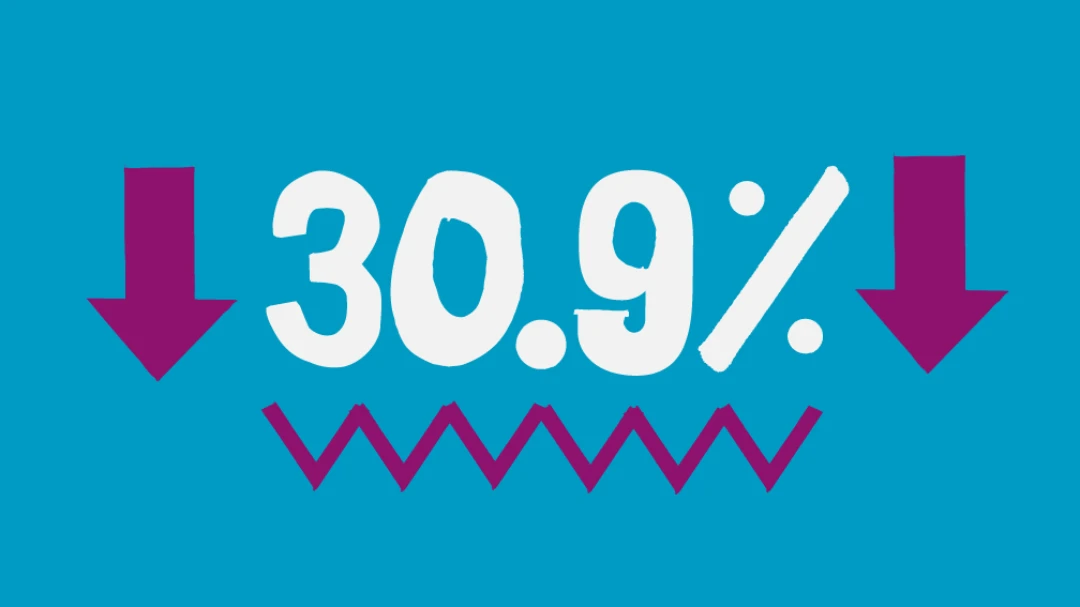
30.9% 5-year relative risk reduction in ischaemic events and all-cause mortality vs. no PCSK9i* P<0.0001 (ARR 7.8%).1

- All patients with ASCVD are at very high or extreme risk of a potentially fatal CV event3
- LDL-C is the primary target for CV risk reduction and PCSK9 inhibitors can reduce LDL-C levels when used alone or in combination with statins3,4
- While clinical trials have established the effectiveness of PCSK9i mAbs across the different stages of ASCVD, real-world data remain limited1
- The OPTIMUS-CLASS study provides real-world evidence on the 5-year impact of PCSK9i mAbs‡ on ischaemic events and all-cause mortality in ASCVD patients without any prior ischaemic events1


The baseline characteristics for the PCSK9i mAb‡ group and no PCSK9i* group were well balanced.1
PCSK9i mAb‡
|
No PCSK9i*
|
Total
|
|
| Male (%) | 50.8 | 50.7 | 50.7 |
| Age | |||
| 18-44 | 1.3 | 1.7 | 1.6 |
| 45-64 | 30.7 | 30.8 | 30.8 |
| 65+ | 68.0 | 67.5 | 67.6 |
| Insurance | |||
| - Medicare Advantage¥ | 68.1 | 69.8 | 69.3 |
| - Commercial | 31.9 | 30.2 | 30.7 |
Adapted from Bhatt et al. 2026.
PCSK9i mAb‡
|
No PCSK9i*
|
Total
|
|
| Coronary Conditions | 76.7 | 76.0 | 76.1 |
| - Stable Angina | 74.7 | 73.5 | 73.8 |
| - Other IHD | 17.3 | 17.2 | 17.2 |
| - Prior Revascularisation | 25.6 | 25.5 | 25.5 |
| - PCI | 16.7 | 16.4 | 16.5 |
| - CABG | 12.0 | 11.9 | 11.9 |
| Ischaemic cerebrovascular disease | 9.4 | 9.6 | 9.6 |
| Peripheral artery disease | 19.1 | 19.4 | 19.3 |
| - Lower extremities | 3.9 | 4.1 | 4.0 |
| - Aorta | 4.9 | 4.9 | 4.9 |
| - OtherII | 10.3 | 10.4 | 10.4 |
Adapted from Bhatt et al. 2026.
PCSK9i mAb‡
|
No PCSK9i*
|
Total
|
|
| Diabetes | 35.9 | 35.8 | 35.9 |
| - No insulin | 23.9 | 23.8 | 23.9 |
| - On insulin | 12.0 | 12.0 | 12.0 |
| Hypertension | 79.5 | 79.5 | 79.5 |
| Liver disease | 5.1 | 5.2 | 5.2 |
| COPD | 9.9 | 9.9 | 9.9 |
| Heart failure | 8.7 | 8.5 | 8.6 |
| Chronic kidney disease | 10.7 | 10.4 | 10.4 |
| - Stage III | 9.2 | 8.9 | 8.9 |
| - Stage IV¶ | 1.5 | 1.5 | 1.5 |
| Atrial fibrillation | 9.7 | 9.7 | 9.7 |
| Tobacco use | 17.6 | 17.7 | 17.6 |
| Cancer | 11.9 | 11.3 | 11.4 |
| - Diagnosis | 8.9 | 9.0 | 8.9 |
| - Medication | 4.8 | 4.6 | 4.6 |
Adapted from Bhatt et al. 2026.
PCSK9i mAb‡
|
No PCSK9i*
|
Total
|
|
| LLT use during 1-year prior to index, % | |||
| Any statin use | 61.0 | 61.6 | 61.4 |
| - Low-intensity | 5.5 | 6.5 | 6.2 |
| - Moderate-intensity | 23.8 | 25.9 | 25.3 |
| - High-intensity | 31.7 | 29.3 | 29.9 |
| Ezetimibe | 33.4 | 33.3 | 33.3 |
| Ezetimibe w/o statin | 11.3 | 11.0 | 11.1 |
| Icosapent ethyl | 3.1 | 3.0 | 3.0 |
| Bempedoic acid | 0.4 | 0.5 | 0.5 |
| Any statin, ezetimibe or bempedoic acid | 72.4 | 72.7 | 72.6 |
| Other CV SOC during 1-year prior to Index, % | |||
| Beta-blockers | 52.6 | 52.3 | 52.4 |
| ACEi / ARB | 58.2 | 58.1 | 58.1 |
| Antiplatelets** | 23.8 | 23.5 | 23.6 |
| Anticoagulants | 10.5 | 10.5 | 10.5 |
Adapted from Bhatt et al. 2026.
PCSK9i mAb‡
|
No PCSK9i*
|
Total
|
|
| Mean (SD), mmol/L | 3.0 (1.1) | 3.0 (1.1) | 3.0 (1.1) |
| Mean (SD), mg/dL | 117.8 (42.0) | 116.1 (43.2) | 116.5 (42.9) |
| Median, mmol/L | 3.1 | 2.9 | 2.9 |
| Median, mg/dL | 118.0 | 112.0 | 113.0 |
Adapted from Bhatt et al. 2026.

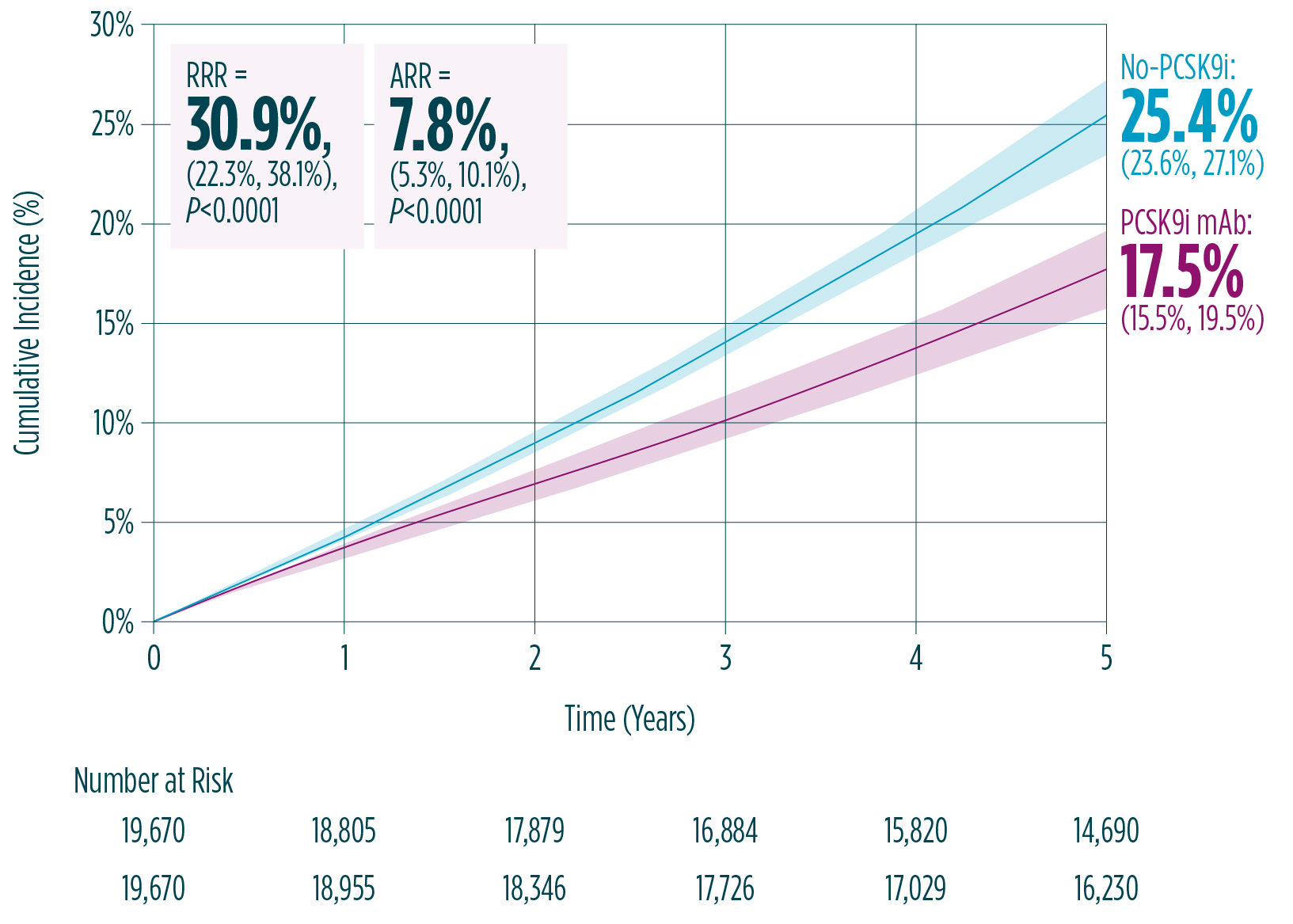
PCSK9i mAb‡ treatment was associated with a 30.9% relative reduction in the risk of nonfatal MI, nonfatal IS or all-cause mortality in ASCVD patients without a prior ischaemic event.1
The estimated 5-year event rate for the composite endpoint of nonfatal MI, nonfatal IS or all-cause mortality was significantly lower in the PCSK9i mAb‡ group vs. the no PCSK9i* group.1
The 5-year event rate was 17.5% (95% CI 15.5, 19.5) in the PCSK9i mAb‡ group (n=6,545) vs. 25.4% (95% CI 23.6, 27.1) in the no PCSK9i* group (n=13,125), resulting in a significant 30.9% relative reduction in the risk of first MACE (ARR 7.8%) (P<0.0001).1
Estimated event rates over time for the primary endpoint with parametric G-formula (ITT)1
A reduction in 5-year event rate was also seen in the PCSK9i mAb‡ group across each individual endpoint, with 28.3%, 26.4% and 28.5% RRR observed across nonfatal MI, nonfatal IS and all-cause mortality event rates, respectively, vs. the no PCSK9i* group.5
Individual endpoint 5-year event rates (ITT)5
PCSK9i mAb‡
|
No PCSK9i*
|
RRR
|
ARR
|
|
| Nonfatal MI | 5.2 (4.3, 6.3) | 7.3 (6.6, 8.1) | 28.3 (12.0, 40.6
[P<0.0001]) |
2.1 (0.8, 3.1
[P<0.0001]) |
| Nonfatal IS | 4.0 (3.1,4.7) | 5.4 (4.6, 6.3) | 26.4 (6.5, 45.7
[P=0.02]) |
1.5 (0.3, 2.7
[P=0.02]) |
| All-cause mortality | 8.7 (7.5, 9.8) | 12.2 (11.2, 13.0) | 28.5 (16.6, 39.1
[P<0.0001]) |
3.5 (2.0, 4.9
[P<0.0001]) |
Adapted from Bhatt et al. 2026. Supplementary Material.
In the ITT population, patients in the PCSK9i mAb‡ group went from an LDL-C level of 117.8 mg/dL to 78.0 mg/dL at follow-up after 5 years.1 This resulted in a 39.8 mg/dL absolute reduction in LDL-C, representing a 33.8% percentage reduction.1 These findings are consistent with the CTT††, which demonstrated a strong association between RRR in MACE per 1 mmol/L reduction in LDL-C.6
Relationship between LDL-C reduction and relative risk reduction in ischaemic events compared to CTT meta-analysis1
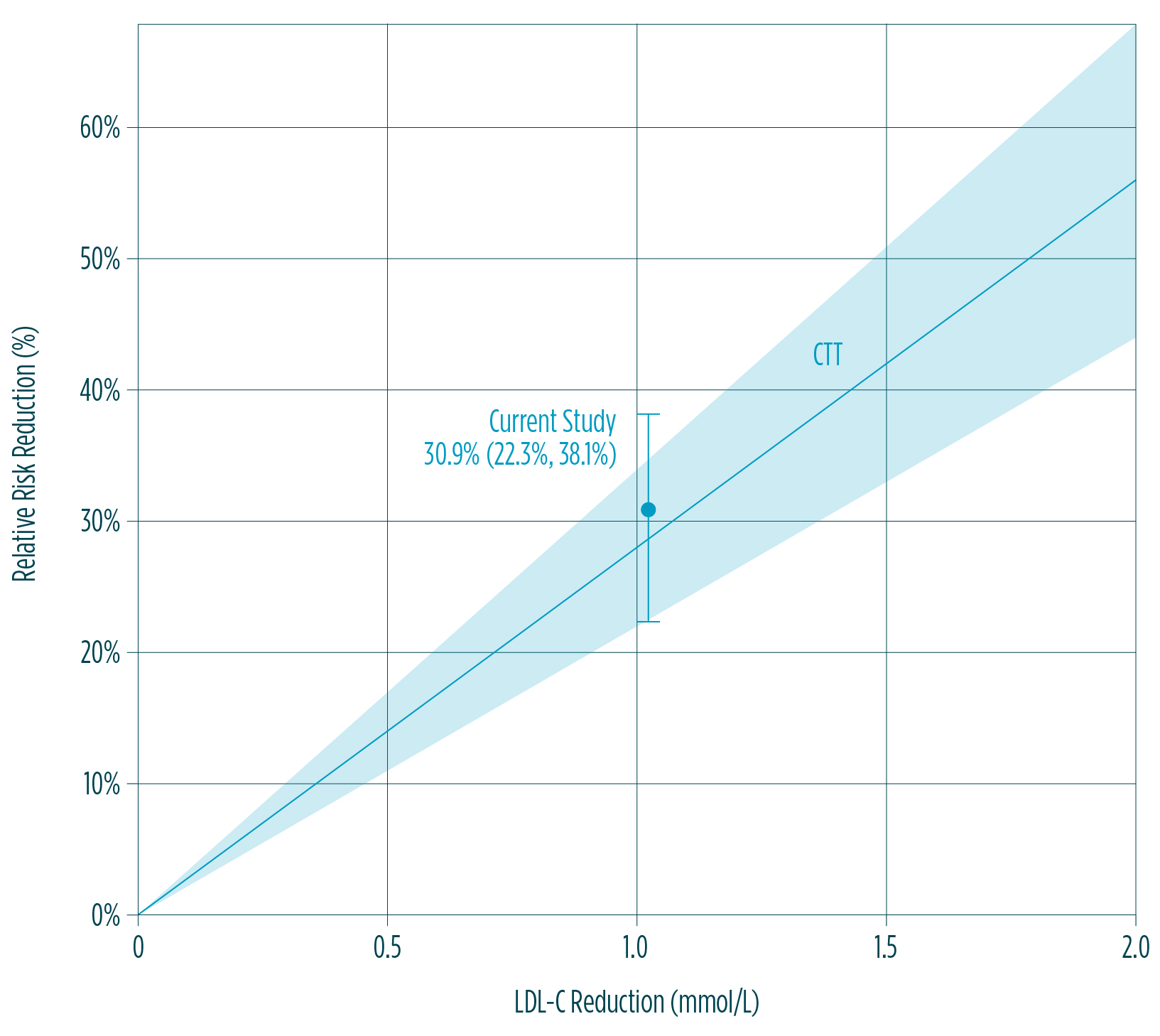
When looking at patients who were treated with or without statins, both the with statins and without statins PCSK9i mAb‡ groups had lower cumulative event rates than their equivalent no PCSK9i* groups.5 Current study 30.9% (95% CI 22.3%, 38.1), CTT RRR 28.8% (95% CI 22.6%, 35.0%)
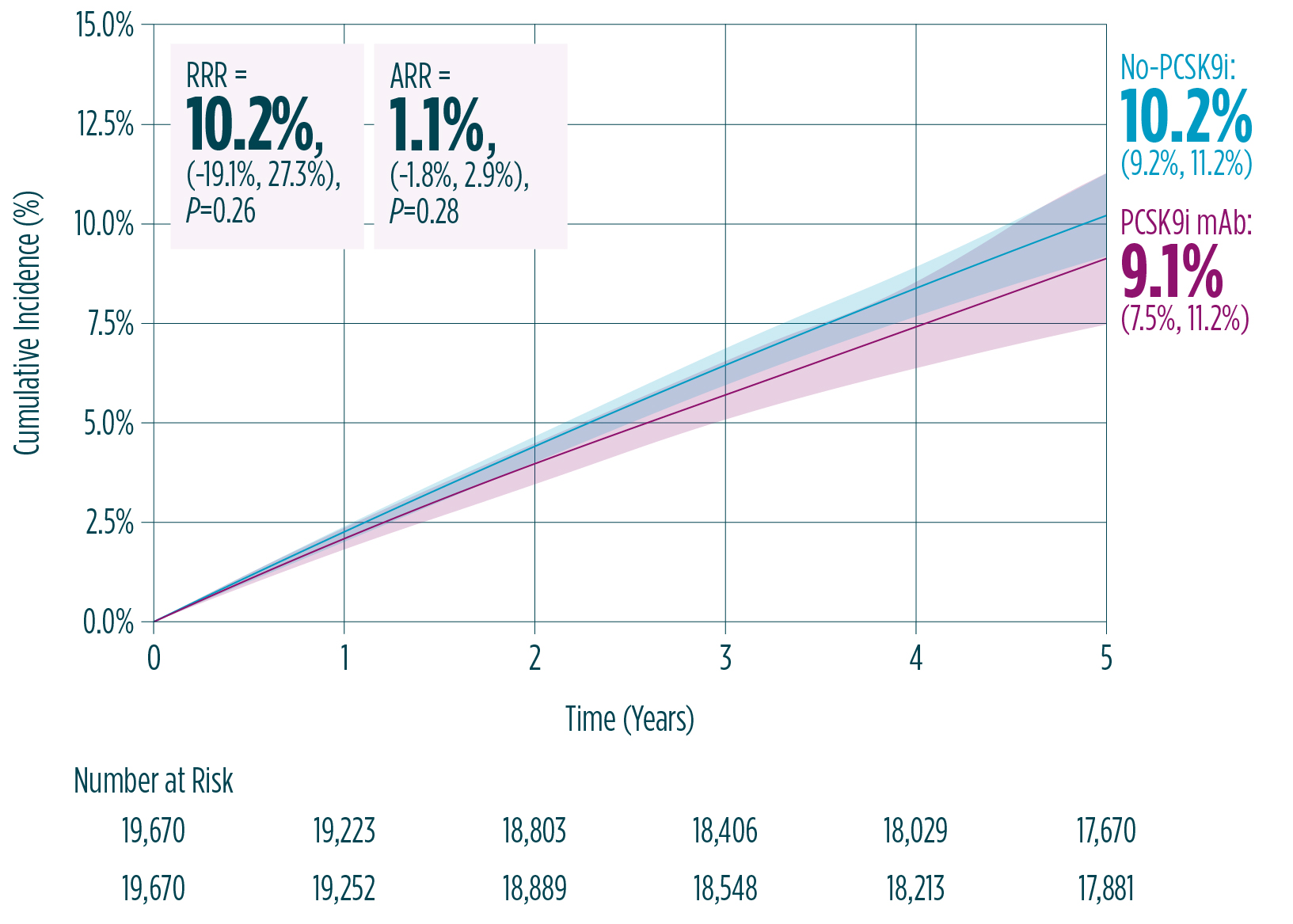
The falsification analysis, used to support the validity of data, found no significant difference between the PCSK9i mAb‡ and no PCSK9i* groups.1
To help determine whether the lower rate of MACE with PCSK9i mAbs‡ VS. no PCSK9i* was confounded by other factors, the study assessed whether PCSK9i mAbs‡ vs. no PCSK9i* was associated with any unexpected benefit in the falsification endpoint, defined as composite of cancer, hospitalised major bleeding or hospitalised sepsis.1 At 5 years, the incidence of the falsification endpoint was similar in the PCSK9i mAbs‡ group (9.1%) and no PCSK9i* group (10.2%), supporting the validity of the MACE data.1
Falsification analysis1
In ASCVD patients without prior ischaemic events, PCSK9i mAb‡ therapy compared with no PCSK9i* treatment was associated with a relative reduction in the risk of ischaemic events or mortality.1
*No PCSK9i represents no PCSK9 monoclonal antibodies (alirocumab or evolocumab) or PCSK9 small interfering RNA (inclisiran).1
+RWE studies can vary substantially in their methodological approaches, which may contribute to heterogeneity or unexpected findings across analyses. Ensuring that key epidemiological principles – such as appropriate time zero definition, new user design considerations, handling of open claims data, and assessment of potential time related biases – are rigorously applied remains essential to generate reliable insights. High quality RWE therefore depends on robust and methodically advanced approaches such as propensity score matching and G-computation used in the study.
‡PCSK9i mAb represents alirocumab or evolocumab.1
¥A claims database, representing an insured population in the US.1
§Represents health plan in the US offered by a private company that contracts with Medicare to provide patients with hospital and medical insurance benefits.1
||Includes any type of disease that is non-coronary, non-cerebrovascular, or does not involve the lower extremities or aorta.1
¶Includes dialysis or renal transplant.1
**Includes clopidogrel, ticagrelor, and prasugrel; 98.8% use in this category was for these agents. Additional agents were anagrelide, cilostazol, dipyridamole (including aspirin combo), pentoxifylline and vorapaxar sulphate.1
++CTT relative risk reduction = 28% (95% CI 22, 34) per mmol/L reduction in LDL-C.1
C Praluent «sanofi-aventis»
Lipidmodifiserende middel, humant monoklonalt antistoff (IgG1). ATC-nr.: C10A X14.
INJEKSJONSVÆSKE, oppløsning 75 mg/ml, 150 mg/ml og 300 mg/2 ml: Hver ferdigfylt penn inneh .: Alirokumab 75 mg, resp. 150 mg og 300 mg, histidin, sukrose, polysorbat 20, vann til injeksjonsvæsker.
PRALUENT er indisert ved: Primær hyperkolesterolemi eller blandet dyslipidemi: Til voksne med primærhyperkolesterolemi (heterozygot familiær og ikke-familiær) eller blandet dyslipidemi, og hos pediatriske pasienter >8 år medheterozygot familiær hyperkolesterolemi (HeFH) som tilleggsbehandling til diett: I kombinasjon med et statin eller statin medannen lipidsenkende behandling hos pasienter som ikke oppnår LDL-kolesterol (LDL-C)-mål med høyeste tolererte dose av etstatin, eller alene eller i kombinasjon med annen lipidsenkende behandling hos pasienter som er statinintolerante, eller der etstatin er kontraindisert.
Påvist aterosklerotisk kardiovaskulær sykdom: Til voksne med påvist aterosklerotisk kardiovaskulær sykdom for åredusere kardiovaskulær risiko ved å senke LDL-C-nivåene , som tillegg til korreksjon av andre risikofaktorer: I kombinasjonmed den maks. tolererte dosen av et statin med eller uten andre lipidsenkende behandlinger, eller, alene eller i kombinasjonmed andre lipidsenkende behandlinger hos pasienter som er statinintolerante, eller der et statin er kontraindisert. Forinformasjon om studieresultater i forhold til effekt på LDL-C, kardiovaskulære hendelser og studerte pasientgrupper, se SPC. Dosering: Anbefalt dose er 75 mg 1 gang hver 2. uke, 150 mg hver 2. uke eller 300 mg hver 4. uke (månedlig). Alle doser kanbrukes som oppstart av behandling. Dosen individualiseres ut fra utgangsnivå av LDL-C, behandlingsmål og respons.
Utvalgt sikkerhetsinformasjon:
Bivirkninger: Vanlige (≥1/100 til <1/10): Generelle: Reaksjon på injeksjonsstedet inkl. erytem/rødhet, kløe, hevelse, smerter/ømhet. Hud: Kløe. Luftveier: Tegn og symptomer fra de øvre luftveiene inkl. smerter i orofarynks, rhinoré, nysing. Sjeldne(≥1/10 000 til <1/1000): Hud: Nummulært eksem, urtikaria. Immunsystemet: Overfølsomhet, overfølsomhetsvaskulitt. Ukjentfrekvens: Generelle: Influensalignende sykdom. Hud: Angioødem. Kontraindikasjoner: Overfølsomhet for innholdsstoffene. Forsiktighetsregler: Brukes med forsiktighet ved alvorlig nedsatt lever- eller nyrefunksjon. Interaksjoner: Klinisk relevanteinteraksjoner forventes ikke. Pakninger og listepriser: 75 mg/ml: 2 stk. kr 5178,40. 6 stk. kr 15462,60. 150 mg/ml: 2 stk. kr5178,40. 6 stk. kr 15462,60. 300 mg/2 ml: 3 stk. kr 15462,60.
Refusjonsprisen er rabattert: Anbudskode: 2580.
For fullstendig informasjon les godkjent FK-tekst eller SPC for Praluent.
Praluent «Sanofi» - Felleskatalogen
Ref 1. Basert på Praluent SPC godkjent av DMP/EMA 17.10.2025.
sanofi-aventis Norge AS - Pb 133, 1325 Lysaker - Tel.: 67 10 71 00. sanofi.no
|
Familiær hyperkolesterolemi* |
Hyperkolesterolemi ved etablert aterosklerotisk sykdom** (sekundærprevensjon) |
|
|
LDL-C >2,6 mmol/l |
FH - sekundærprevensjon |
Med en av følgende risikofaktorer:
|
|
LDL-C >3,6 mmol/l |
FH - primærprevensjon (barn og voksne fra og med 8 år) |
Uten tilleggsrisiko |
|
Krav til tidligere behandling: |
Refusjon ytes når alirokumab brukes som tillegg til statin og/eller ezetimib hos pasienter som ikke oppnår LDL-nivåer under grenseverdiene nevnt ovenfor. Se følgende krav *** |
|
|
Spesialistkrav: |
Forskrivning skal være instituert av spesialist i indremedisin, kardiologi, endokrinologi, geriatri, pediatri, nevrologi eller av lege ved tilsvarende sykehusavdeling |
|
*Gentest må være utført
** Sekundærprofylakse etter akutt koronarsykdom (hjerteinfarkt, ustabil angina med sykehusinnleggelse), koronar- eller annenarteriell revaskularisering, angina pectoris, iskemisk hjerneslag eller symptomatisk perifer arteriell sykdom
*** For brukere som tåler statiner: Høyeste tolererbare dose statin i kombinasjon med ezetimib. For brukere som ikke tålerstatiner (statinintoleranse): Minst to forskjellige statiner i laveste dose i kombinasjon med ezetimib. Intoleranse mådokumenteres i journal av forskrivende lege. Ved absolutt kontraindikasjon mot statiner: ezetimib i monoterapi. Refusjonskoder ICD: -26 etablert aterosklerotisk sykdom (sekundærprevensjon) og E78 ren hyperkolesterolemi. ICPC: -26 etablert atersklerotisk sykdom (sekundærprevensjon) og T93 hyperkolesterolemi Ref 2: https://www.felleskatalogen.no/medisin/blaarev-register/c10ax14-1 (01.01.2025)
ACEi = angiotensin convertase enzyme inhibitor; AE = adverse event; ARB = angiotensin receptor blocker; ARR = absolute risk reduction; ASCVD = atherosclerotic cardiovascular disease; CABG = coronary artery bypass graft; CI = confidence interval; COPD = chronic obstructive pulmonary disease; CTT = Cholesterol Treatment Trialists' Collaboration; CV = cardiovascular; HeFH = heterozygous familial hypercholesterolaemia; HIS = high-intensity atorvastatin; IHD = ischaemic heart disease; IS = ischaemic stroke; ITT = intention-to-treat; LDL-C = low-density lipoprotein cholesterol; LLT = lipid-lowering therapy; mAb = monoclonal antibody; MACE = major adverse cardiovascular event; MI = myocardial infarction; PCI = percutaneous coronary intervention; PCSK9 = proprotein convertase subtilisin/ kexin type 9; PCSK9i = proprotein convertase subtilisin/kexin type 9 inhibitor; RNA = ribonucleic acid; RRR = relative risk reduction; RWE = real-world evidence; SD = standard deviation; SOC = standard of care.
-
Bhatt DL, Perrone Filardi P, Khan I, et al. PCSK9 inhibitor treatment and outcomes in patients with atherosclerotic cardiovascular disease but without prior ischaemic events: an observational study. Eur Heart J. 2026;ehag176.
-
Naimi Al, Cole SR and Kennedy EH. An introduction to g methods. Int J Epidemiol. 2017;46(2):756-762.
-
Mach F, Koskinas KC, Roeters van Lennep JE, et al. 2025 Focused Update of the 2019 ESC/EAS Guidelines for the management of dyslipidaemias. Eur Heart J. 2025;46(42):4359-4378.
-
Schwartz GG, Steg PG, Szarek M, et al. Alirocumab and cardiovascular outcomes after acute coronary syndrome. N Engl J Med. 2018;379(22):2097-2107.
-
Bhatt DL, Perrone Filardi P, Khan I, et al. PCSK9 inhibitor treatment and outcomes in patients with atherosclerotic cardiovascular disease but without prior ischaemic events: an observational study. Eur Heart J. 2026;ehag176. Supplementary material.
-
Cholesterol Treatment Trialists' Collaboration. Efficacy and safety of more intensive lowering of LDL cholesterol: a meta-analysis of data from 170,000 participants in 26 randomised trials. Lancet. 2010;376(9753):1670-1681.
-
PRALUENT (alirocumab) Summary of Product Characteristics. Paris, France: sanofi-aventis groupe Oct 2025.
Dette kan også være av interesse

What is PRALUENT®(alirocumab)?
PRALUENT: a PCSK9i that ticks all the boxes1–4 PRALUENT is a PCSK9i that reduces the levels of LDL-C in the blood.2 It is a fully human IgG1 monoclonal antibody that works by inhibiting the binding of PCSK9 to LDL- receptors. As a result, PRALUENT increases the number of LDL-receptors available to clear LDL, thereby lowering LDL-C levels.2 Elevated LDL-C levels have been significantly associated with cardiovascular disease such as heart attacks and strokes.1


Why choose PRALUENT®?
The usual starting dose for PRALUENT is 75 mg administered subcutaneously once every 2 weeks. Patients requiring larger LDL-C reduction (>60%) may be started on 150 mg once every 2 weeks, or 300 mg once every 4 weeks (monthly), administered subcutaneously.2