
The Importance of Lung Function in Severe Asthma - A Clinical Perspective

In severe asthma, lung function is significantly impaired, characterized by reduced FEV₁ and a decreased FEV₁/FVC ratio, reflecting persistent airflow obstruction.1
Chronic airway inflammation, together with airway remodeling, contributes to progressive and partly irreversible structural changes2. These alterations play a key role in the long-term decline in lung function observed in this patient population.
From a clinical standpoint, this has substantial implications for disease burden and patient quality of life, including3,4:

Reduced exercise tolerance

Sleep disturbances

Impaired daily functioning
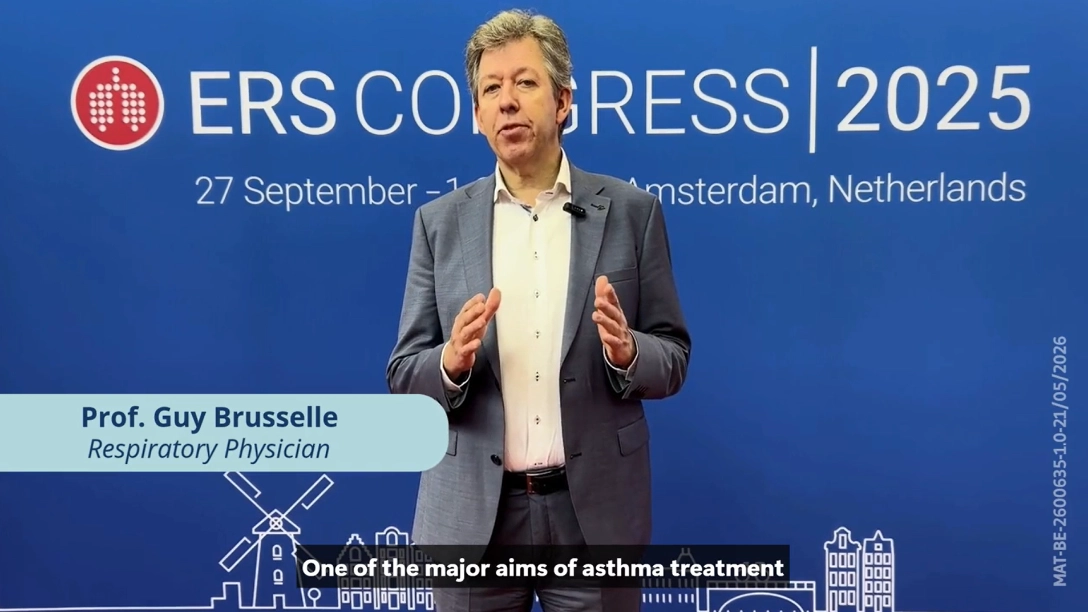
Watch Prof. Guy Brusselle explains how severe asthma impacts lung function and how to monitor it
How is Lung Function Measured?
Spirometry is a common technique to measure lung function1 |
- On post-bronchodilator (BD) spirometry1,5
- Improvement in FEV1 in patients with reduced pre-BD FEV1 is an indicator of BD responsiveness1
- Reduced FEV1 may suggest airway remodelling5 - FEV1/FVC ratio can be used in conjunction with FEV1 to identify airway obstruction and expiratory airflow limitation1,6
- Low FEV1 is a risk factor for lung function decline1
Did you know? |
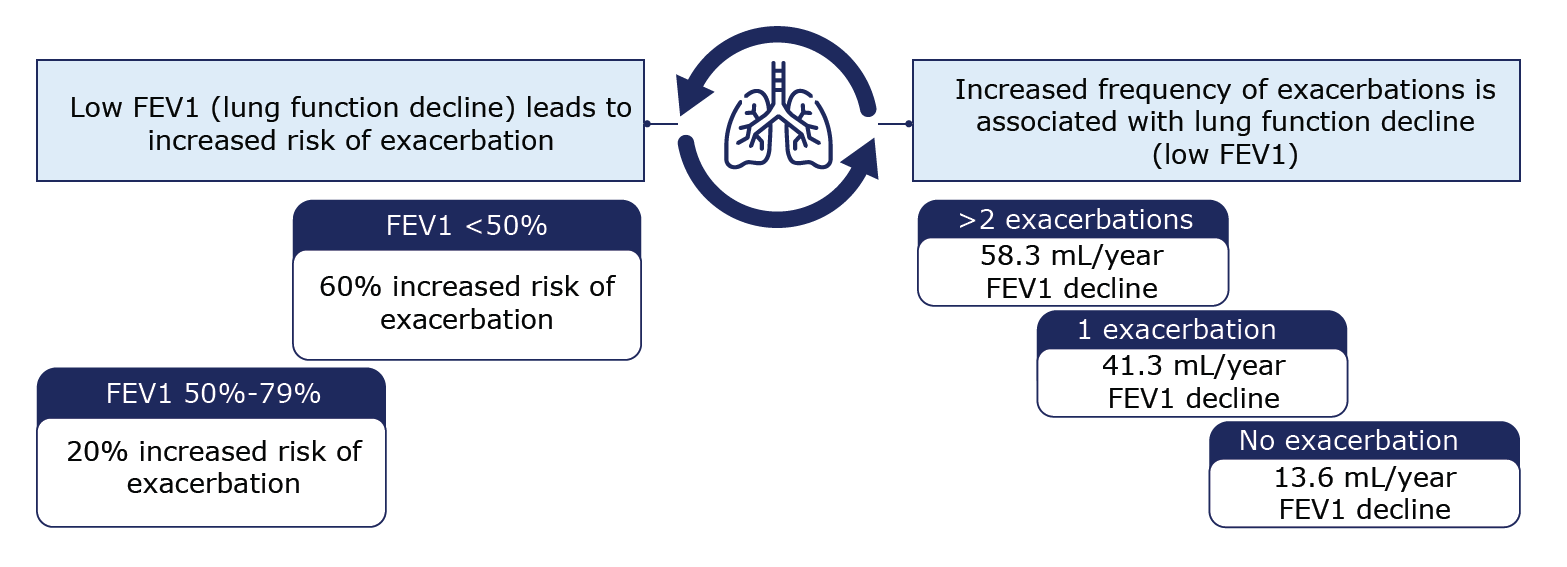
The declining FEV1 is a key indicator of asthma exacerbation risk |
Lung function decline is associated with high exacerbation risk, and repeated exacerbation events further reduce FEV1,7,8,9
Assessing lung function is crucial for optimal asthma management in patients
Systematic monitoring of lung function is therefore essential in the management of severe asthma. Repeated measurements not only provide insight into disease severity but are also critical for10:
- Patient phenotyping
- Evaluation of treatment response
- Optimization and adjustment of therapy, including the use of biologics
FeNO can help identify patients with asthma at risk of rapid lung function loss9 |

FeNO is a predictor of accelerated decline in lung function in patients with severe asthma. FeNO≥20 ppb is associated with a relative risk of 1.9 of having an accelerated decline in FEV111*
As highlighted in GINA guidelines, lung function assessment plays a central role in evidence-based decision-making and the individualization of treatment strategies in patients with severe asthma1.
FEV1 Improvement as a Key Component of Asthma Remission criteria
Improvement in FEV1 is increasingly recognized as a fundamental component of asthma remission criteria, as it reflects restoration of lung function beyond symptom control alone. Emerging international consensus statements include FEV1 optimization or normalization among clinical remission criteria, with a commonly proposed threshold of FEV1 ≥ 80% of predicted value12.
Key messages |
Low FEV1 is associated with lung function decline and risk of exacerbations.1,7
|
Abbreviations
BP: Bronchodilator ; FeNO: Fractional exhaled Nitric Oxide ; FEV: Forced Expiratory Volume in 1 second ; FVC : Forced Vital Capacity ; GINA: Global Initiative for Asthma ; ppb: part ber billion
References
-
Global Initiative for Asthma (GINA). Global Strategy for Asthma Management and Prevention. 2026 update. Fontana (WI): Global Initiative for Asthma; 2026. Available at: https://ginasthma.org. Accessed July 10, 2026.
-
Pascual RM, Peters SP. Airway remodeling contributes to the progressive loss of lung function in asthma. Chest. 2005.
-
Hyland ME, et al. Quality of life in severe asthma. Clin Exp Allergy. 2012.
-
Bime C, et al. Association of asthma with sleep quality and sleep-disordered breathing. Ann Allergy Asthma Immunol. 2012.
-
Bui DS, Perret JL, Walters EH, et al. Lifetime risk factors for pre- and post-bronchodilator lung function decline: a population-based study. Ann Am Thorac Soc. 2020;17(3):302–312.
-
Merck Manual Professional Version. Airflow, Lung Volumes, and Flow-Volume Loop. Available at: https://www.merckmanuals.com/professional. Accessed December 13, 2023.
-
Ortega H, Yancey SW, Keene ON, et al. Asthma exacerbations associated with lung function decline in patients with severe eosinophilic asthma. J Allergy Clin Immunol Pract. 2018;6(3):980–986.
-
Khan AH, Gray C, Eckert L, et al. Impact of baseline lung function on future exacerbations in patients with moderate-to-severe asthma. J Asthma Allergy. 2022;15:1639–1644.
-
Matsunaga K, Hirano T, Oka A, et al. Progression of irreversible airflow limitation in asthma: correlation with severe exacerbations. J Allergy Clin Immunol Pract. 2015;3(5):759–764.e1.
-
Kuruvilla ME, Lee FE, Lee GB. Understanding Asthma Phenotypes, Endotypes, and Mechanisms of Disease. Clin Rev Allergy Immunol. 2019 Apr;56(2):219-233. doi: 10.1007/s12016-018-8712-1. PMID: 30206782; PMCID: PMC6411459.
-
Van Veen IH, Ten Brinke A, Sterk PJ, Sont JK, Gauw SA, Rabe KF, Bel EH. Exhaled nitric oxide predicts lung function decline in difficult-to-treat asthma. Eur Respir J. 2008;32(2):344–349. doi:10.1183/09031936.00135907.
-
Perez-de-Llano L, Scelo G, Tran TN, et al. Exploring definitions and predictors of severe asthma clinical remission after biologic treatment in adults. Am J Respir Crit Care Med. 2024;210(7):869–880.
Related pages
SE-FILMEN-HÄR
