Cycle of Recurrence: A Challenge in CRSwNP Patients

Chronic rhinosinusitis with nasal polyps (CRSwNP) is a type 2 inflammatory disease associated with frequent recurrence despite effective treatments.1–5
Understanding the role of type 2 inflammation, contributing factors, and treatment strategies, including biologics, can improve management and prevent relapse, potentially offering better outcomes for CRSwNP patients.1–7
Overview of CRSwNP |
- CRSwNP is predominantly driven by type 2 inflammation.1,2
- Despite standard of care (SoC) treatments such as intranasal corticosteroids (INCS), systemic corticosteroids (SCS), and endoscopic sinus surgery (ESS), recurrence of nasal polyps is common.2,5–8
- Common symptoms include loss of smell and nasal congestion, significantly impacting patients' quality of life.1,3
- Persistent inflammation can contribute to the recurrence of nasal polyps, even after surgical intervention.4
- EPOS 2020 and ICAR 2021 guidelines recommend biologics for CRSwNP patients.3,9
Type 2 inflammation plays a central role in CRSwNP, affecting up to 87% patients1,10 |
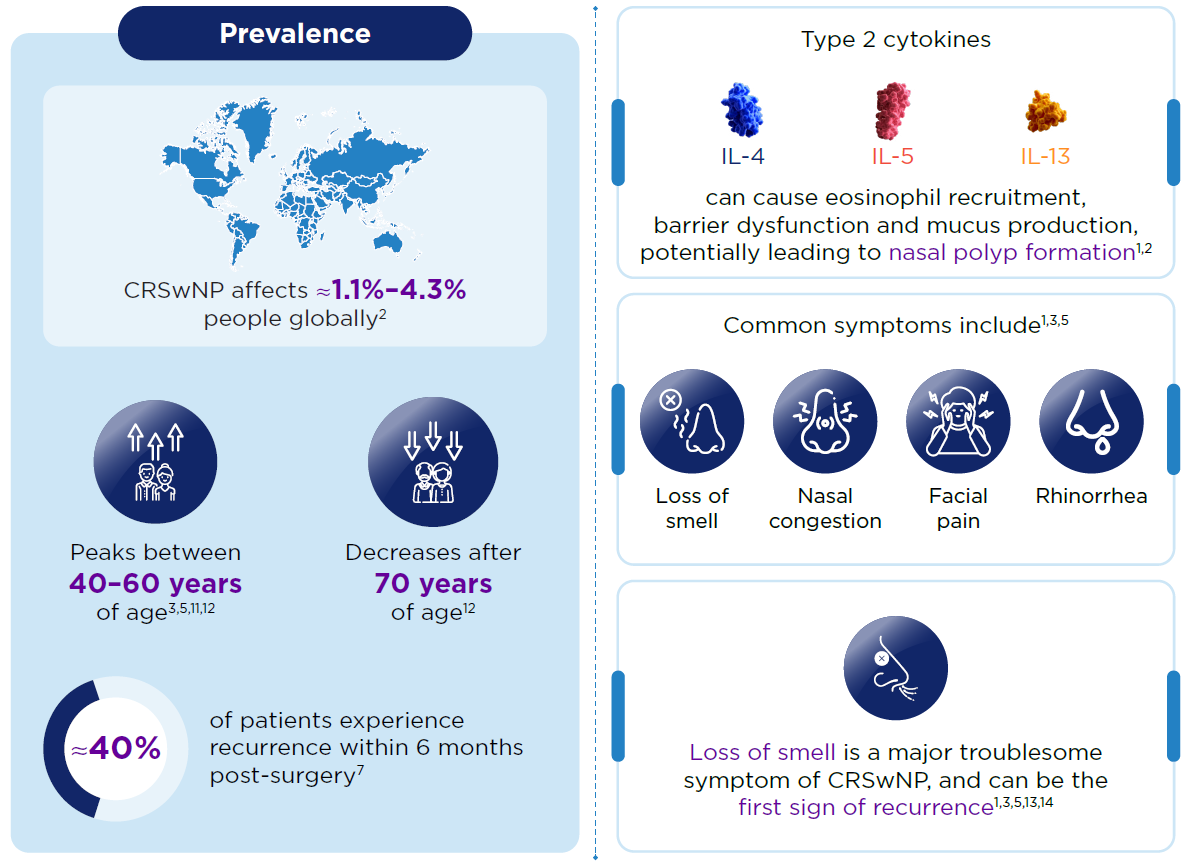
Recurrence of nasal polyps after surgical interventions remains a significant challenge in CRSwNP patients5 |
Recurrence of CRSwNP is defined as the persistence of postoperative endoscopic edema or polyps for more than one follow-up visit, lasting at least 3 months, requiring changes in treatment, and not attributable to concurrent upper respiratory infection.12 The presence of chronic type 2 inflammation may contribute to the recurrence of CRSwNP.2
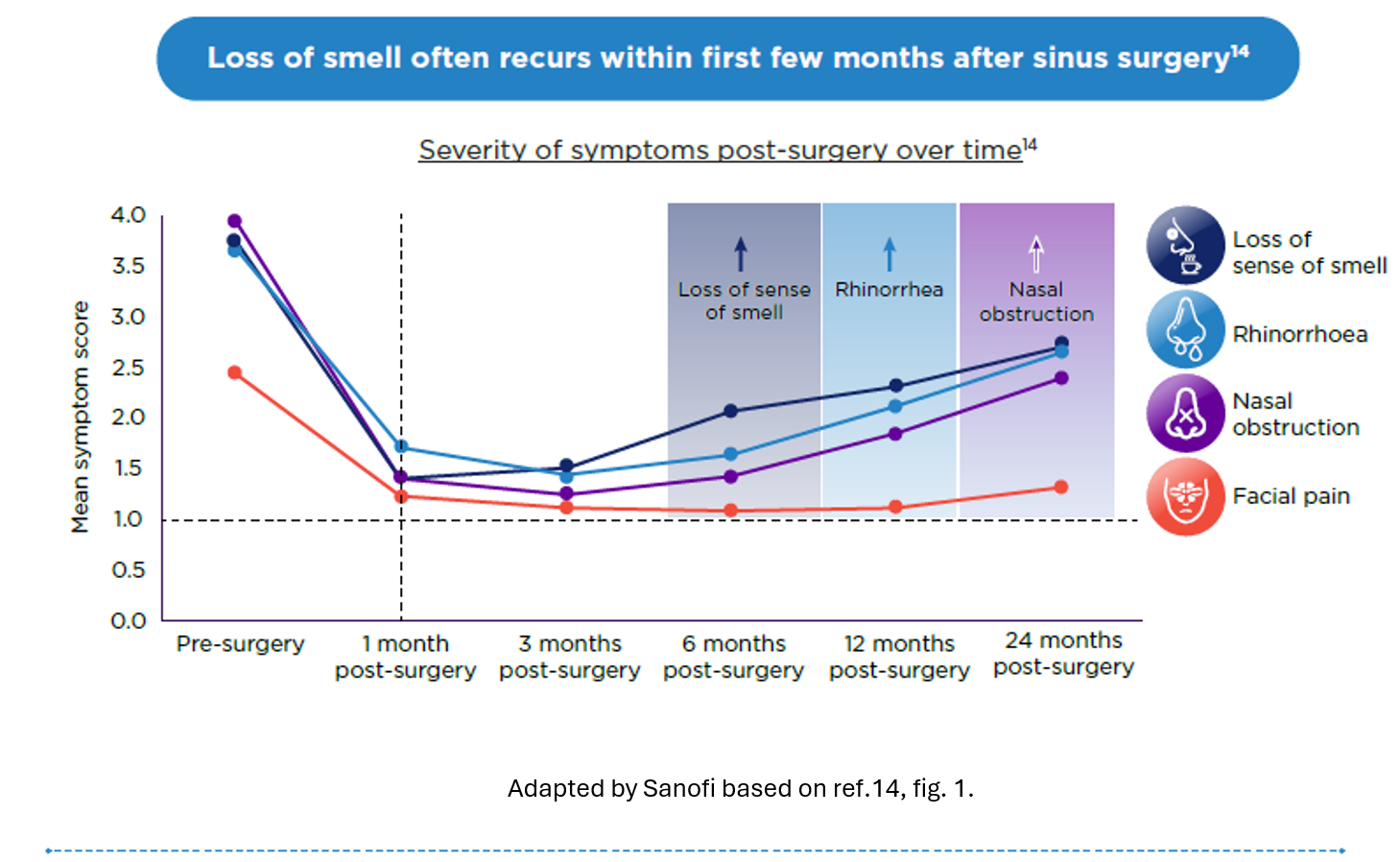
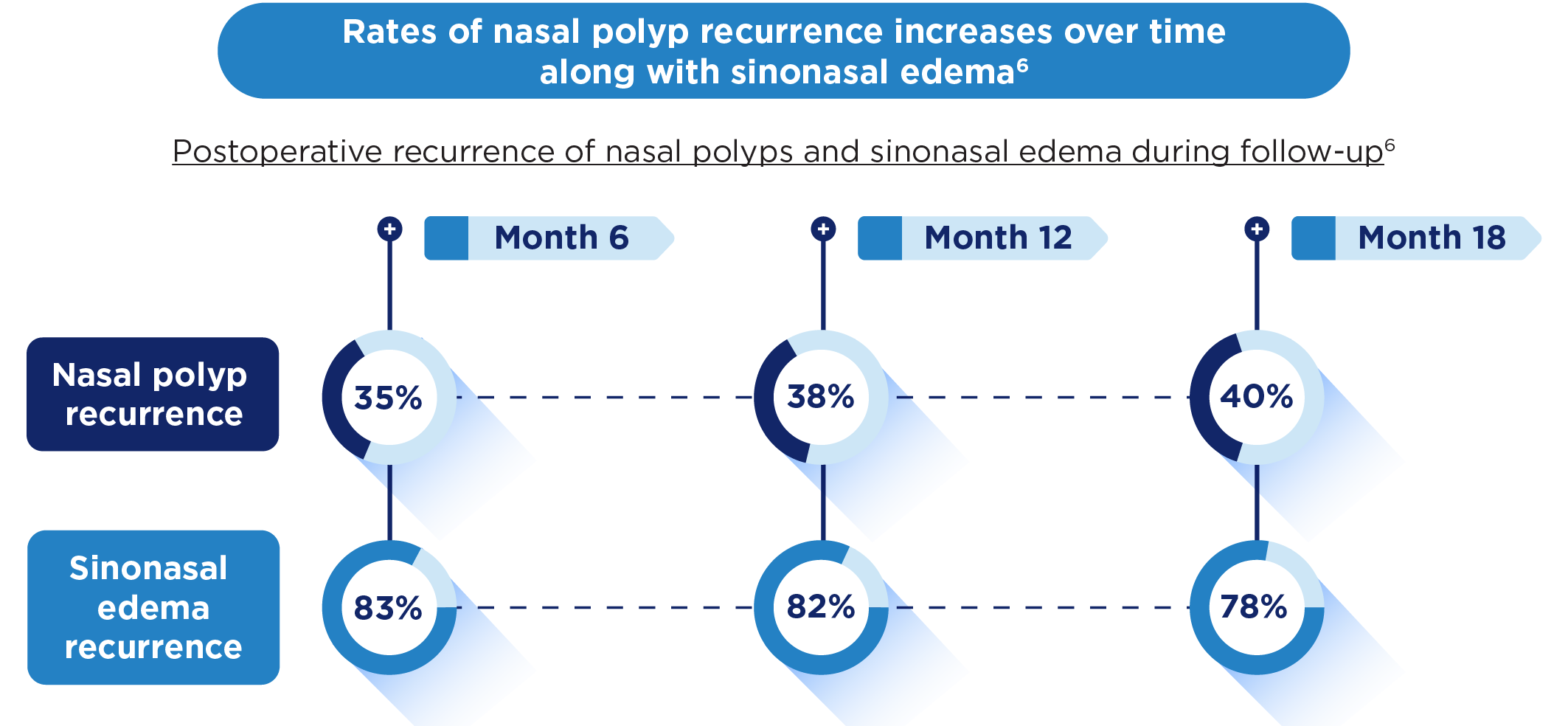
Recurrence of nasal polyps could be a function of untreated chronic inflammation5 |
Multimodal treatment approach is recommended for managing CRSwNP4,15

1st Line: INCS3,8,15,16
Long-term use reduces nasal polyp size and lowers the risk of recurrence after ESS.
2nd Line: SCS3,8,15–17
- No more than 1–2 courses annually.
- Recommended for severe exacerbations and partial/ uncontrolled condition.

Nasal Surgery8,16,18
- Removes nasal polyp tissue and diseased mucosa, improving airflow and symptom burden.
- Considered when medical treatments fail.
These treatments offer temporary relief but do not fully address type 2 inflammation, potentially leading to nasal polyp recurrence2,5–8

Guideline recommendation3,9
The EPOS 2020 and ICAR 2021 guidelines recommend biologics for those who do not respond to conventional therapies.

Biologic Therapy1,8,13,15,18
Targets type 2 inflammation, particularly those with severe or refractory disease.

Response to biologics is assessed by3
- Reduced nasal polyp.
- Decreased corticosteroid use.
- Improved smell and QoL.
CRSwNP, chronic rhinosinusitis with nasal polyps; EPOS, European Position Paper on Rhinosinusitis and Nasal Polyps; ESS, endoscopic sinus surgery; ICAR, International consensus statement on allergy and rhinology; IL, interleukin; INCS, intranasal corticosteroids; QoL, quality of life; SCS, systemic corticosteroids; SoC, standard of care.
-
Bachert C, et al. Front Immunol. 2024;15:1356298;
-
Maspero J, et al. ERJ Open Res. 2022;8(3):00576–2021;
-
Fokkens WJ, et al. Rhinology. 2020;58(Suppl 29):1–464;
-
De Corso E, et al. Acta Otorhinolaryngol Ital. 2023;43(Suppl. 1):S3-S13;
-
Bachert C, et al. J Asthma Allergy. 2021;14:127–134;
-
DeConde AS, et al. Laryngoscope. 2017;127(3):550–555;
-
Levi L, et al. Eur Arch Otorhinolaryngol. 2024;281(11):5847–5856;
-
Desrosiers M, et al. Rhinology. 2021;59(3):301–311;
-
Orlandi RR, et al. Int Forum Allergy Rhinol. 2021; 11(3):213–739;
-
Stevens WW, et al. J Allergy Clin Immunol Pract. 2019;7(8):2812–2820.e3;
-
Merrill T, et al. Clin Interv Aging. 2022; 17:685–698;
-
Cavaliere C, et al. J Pers Med. 2024;14(3):297;
-
Soler ZM, et al. Adv Ther. 2024;41(12): 4384–4395;
-
Bakhshaee M, et al. Iran J Otorhinolaryngol. 2016;28(85):125–134;
-
Han JK, et al. Int Forum Allergy Rhinol. 2021;11(10):1407–1416;
-
Gevaert P, et al. Int Forum Allergy Rhinol. 2022;12(11):1413–1423;
-
Rank MA, et al. Pol Arch Intern Med. 2023;133(11):16611;
-
Norelli F, et al. J Clin Med. 2024;13(4):1066.
Dette kan også være av interesse

SINUS-24/SINUS-52 Demonstrated Reduced Need for Surgery and Oral Corticosteroids — Dupilumab Real-World Data Reinforces with 100% Reduction in the First Year of Treatment in Patients with Severe Uncontrolled CRSwNP
This Italian monocentric study (De Corso et al., 2022) evaluated the real-life effectiveness of dupilumab over the first year of treatment of severe Chronic Rhinosinusitis with Nasal Polyps (CRSwNP) (N=57).2 The results from this real-life observational study reinforces the efficacy of dupilumab demonstrated in the SINUS-24 and SINUS-52 randomized clinical trials and both the study design and results are consistent with the approved SmPC.1,2,3