
Deliver-T (RWE Study): New Findings on Toujeo® for T2D Management Following Dual GIP/GLP-1 RA Therapy

Prescribing Information Link
Indication: Toujeo® is indicated for the treatment of diabetes mellitus in adults, adolescents and children from the age of 6 years.
Introduction
Type 2 diabetes (T2D) is a progressive condition that presents persistent challenges in achieving glycemic control.1
RWE showed that about 50% of people with T2D still struggled to achieve their glycemic targets despite significant therapeutic advances |
As the disease progresses, treatment intensification becomes necessary, with many individuals ultimately requiring injectable therapies to achieve optimal glycemic control.1
Bridging Evidence Gaps: Basal Insulin Use in T2D After GLP-1/GIP Therapy
The updated American Diabetes Association (ADA) 2025 Standards of Care recommend tirzepatide as one of the first-line injectable option for adults with T2D with HbA1c levels >7.0%. However, when glycemic targets remain unmet despite GLP-1 RA therapy (e.g. tirzepatide), treatment intensification with basal insulin (BI) is recommended.3
Toujeo® (Insulin glargine 300 U/mL), a second-generation long-acting BI, is indicated for treatment of T2D in insulin-naïve adults with inadequate glycemic control (HbA1c >7.0%) and and showed a proven efficacy and safety profile.4-6 Understanding its role following GLP-1 RA therapy is essential to guide clinical decisions and optimize long-term outcomes.
Addressing the Knowledge Gap: DELIVER-T Study
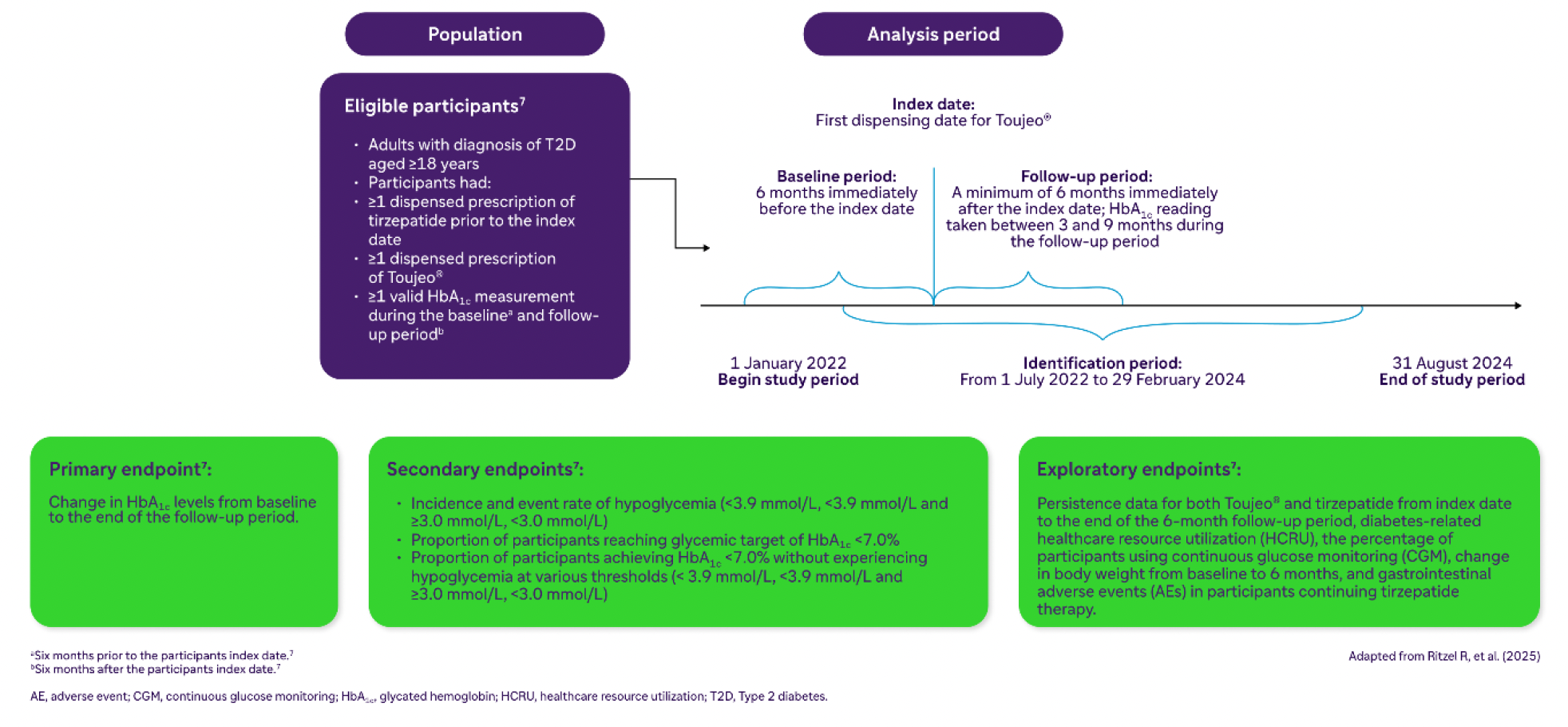
DELIVER-T is the first observational, retrospective, real-world evidence study that evaluated glycemic control in insulin-naïve people with T2D who had elevated HbA1c levels while receiving tirzepatide and who were newly intensified with Toujeo®.7
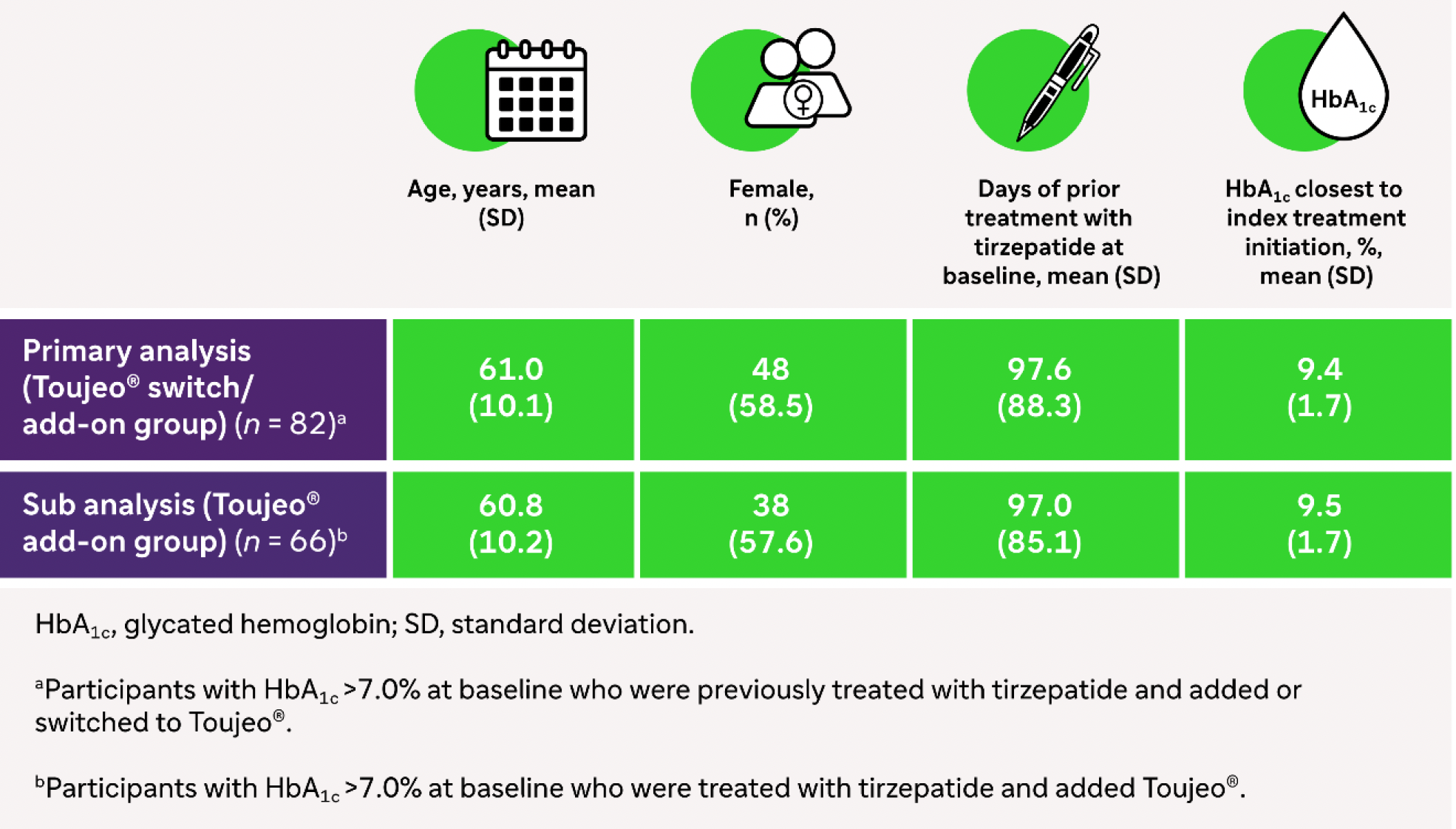
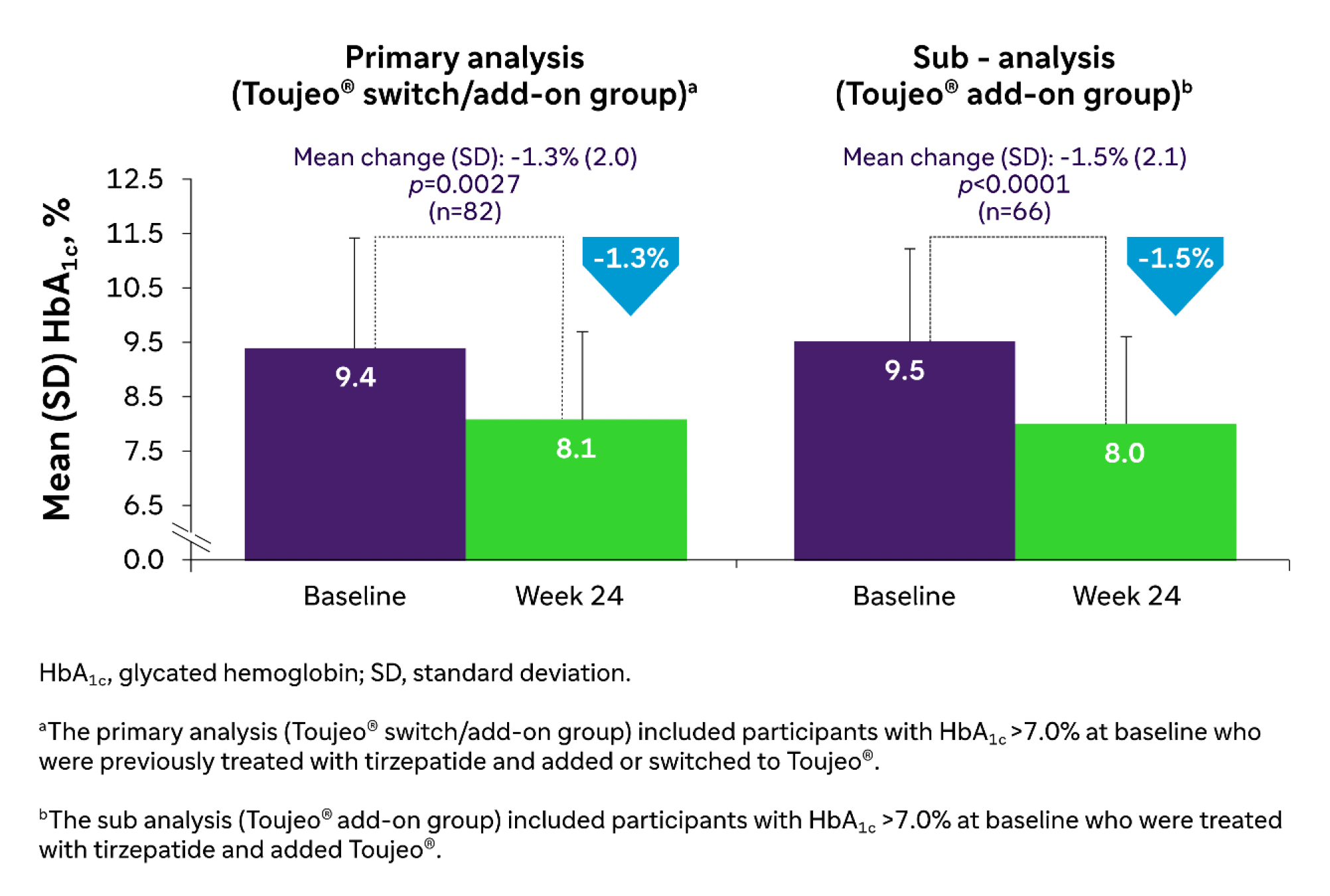
Initiating Toujeo® in insulin-naïve adults with T2D who, while on tirzepatide therapy still had an elevated HbA1c resulted in statistically significant reductions in HbA1c from baseline to week 24 in both primary analysis and sub-analysis groups.7
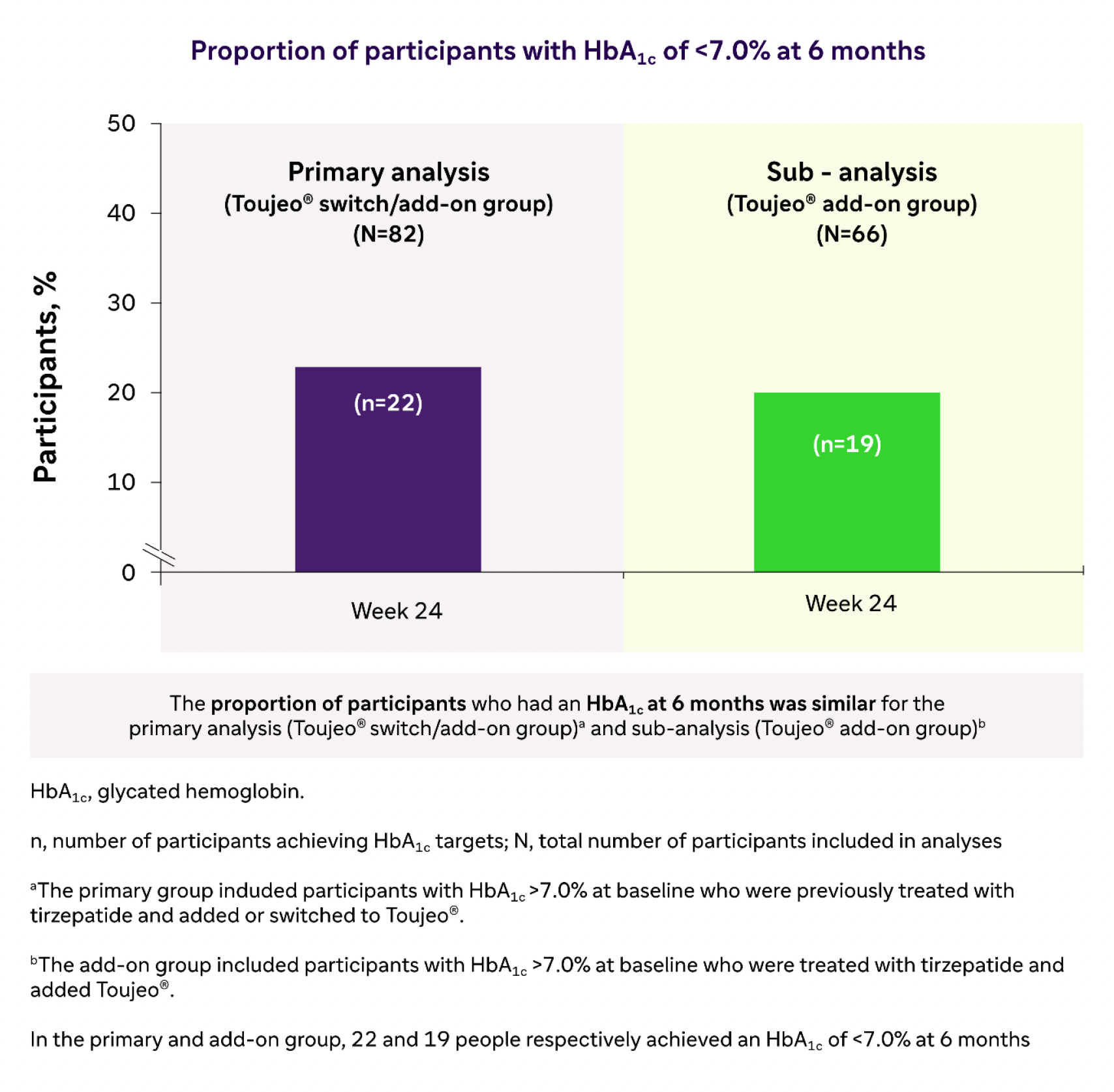
In addition, an increase in participants achieving the target HbA1c <7.0% was observed at 6 months in both groups.7
No hypoglycemic events were recorded in the database, and no hypoglycemia-related doctor visits were reported during the 6-month follow-up period across both groups.7
Persistence with both tirzepatide and Toujeo® was generally maintained during the 6-month followup, with median treatment durations exceeding 180 days for each therapy. CGM use increased notably across all groups. Diabetes-related hospitalizations and emergency visits remained low, and no hypoglycemia-related healthcare utilization was reported.7
Conclusion
| For insulin-naïve adults with T2D who, while on tirzepatide and OAD (oral antidiabetic agents) treatment continued to have an elevated HbA1c initiating Toujeo® led to significant reductions in HbA1c and improved achievement of glycemic targets (<7.0%). Similar results were observed when Toujeo® was added to ongoing tirzepatide therapy. |
Abbreviations
ADA, American Diabetes Association; AE, adverse event; BI, basal insulin; CGM, continuous glucose monitoring; GIP, glucose-dependent insulinotropic polypeptide; GLP-1 RA, glucagon-like peptide-1 receptor agonist; HbA1c, glycated hemoglobin; HCRU, healthcare resource utilization; mmol/L, millimole per liter; OAD, oral antidiabetic agent; SD, standard deviation; T2D, Type 2 diabetes; U/mL, Units per milliliter.
-
Kendall DM, Cuddihy RM, Bergenstal RM. Clinical application of incretin-based therapy: therapeutic potential, patient selection and clinical use. Am J Med. 2009;122(6 Suppl):S37- S50.
-
Aschner P, Gagliardino JJ, Ilkova H, et al. Persistent poor glycaemic control in individuals with type 2 diabetes in developing countries: 12 years of real-world evidence of the International Diabetes Management Practices Study (IDMPS). Diabetologia. 2020;63(4):711-721.
-
American Diabetes Association Professional Practice Committee. 9. Pharmacologic Approaches to Glycemic Treatment: Standards of Care in Diabetes-2025. Diabetes Care. 2025;48(1 Suppl 1):S181-S206.
-
Bailey TS, Gill J, Jones S M, Shenoy L, Nicholls C, Westerbacka J. Real-world outcomes of addition of insulin glargine 300 U/mL (Gla-300) to glucagon-like peptide-1 receptor agonist (GLP-1 RA) therapy in people with type 2 diabetes: The DELIVER-G study. Diabetes Obes Metab. 2022;24(8):1617-1622.
-
Candido R, Nicolucci A, Larosa M, Rossi MC, Napoli R; RESTORE-G (Retrospective analysis on the therapeutic approaches after GLP-1 RA treatment in type 2 diabetes patients) Study Group. Treatment intensification following glucagon-like peptide-1 receptor agonist treatment in type 2 diabetes: The RESTORE-G real-world study. Nutr Metab Cardiovasc Dis. 2023;33(11):2294-2305.
-
Bolli GB, Riddle MC, Bergenstal RM, et al. New insulin glargine 300 U/ml compared with glargine 100 U/ml in insulin-naïve people with type 2 diabetes on oral glucose-lowering drugs: a randomized controlled trial (EDITION 3). Diabetes Obes Metab. 2015;17(4):386-394.
-
Adis Journals on behalf of; Ritzel, Robert; J. Davies, Melanie; Hao, Lichen; Ji, Linong; MK, Lintu; et al. (2025). Real-World Effectiveness of Insulin Glargine 300 U/mL in People with Type 2 Diabetes Previously Treated with Tirzepatide: The DELIVER-T Study. Adis Journals. Media.
TOUJEO® (insulin glargine 300 units/ml) – Abbreviated Prescribing Information
NAME AND PRESENTATION: Toujeo® 300 units/ml SoloStar, solution for injection in a prefilled pen. Toujeo® 300 units/ml DoubleStar, solution for injection in a pre-filled pen. 1 ml of solution contains 300 units of insulin glargine. Each SoloStar prefilled pen contains 1,5 ml of solution for injection (equivalent to 450 units). Each DoubleStar pen contains 3 ml of solution for injection (equivalent to 900 units). THERAPEUTIC INDICATIONS: Treatment of diabetes mellitus in adults, adolescents and children from the age of 6 years. POSOLOGY AND METHOD OF ADMINISTRATION*: Toujeo® is a basal insulin for once-daily administration at any time of the day, preferably at the same time every day. When needed, patients can administer Toujeo® up to 3 hours before or after their usually time of administration. The dose regimen (dose and timing) should be adjusted according to individual response. In type 1 diabetes mellitus, Toujeo® is to be used once-daily and must be combined with short-/rapid-action insulin to cover mealtime insulin requirements. In patients with type 2 diabetes mellitus, the recommended daily starting dose is 0.2 units/kg. Toujeo® can also be given together with other anti-hyperglycaemic medicinal products. Switch: When switching from insulin glargine 100 units/ml to Toujeo®, this can be done on a unit-to-unit basis. When switching from a treatment regimen with an intermediate or long-action insulin to a regimen with Toujeo®, a change of the dose of the basal insulin may be required and the concomitant anti-hyperglycaemic treatment may need to be adjusted. Close metabolic monitoring is recommended during the switch and in the initial weeks thereafter. For switch details see full SmPC. Special populations: Toujeo® can be used in elderly people, renal and hepatic impaired patients and adolescents and children ≥6 years. Renal impairment & hepatic impairment: insulin requirements may be diminished. Elderly: progressive deterioration of a renal function may lead to a steady decrease in insulin requirements. Children: Toujeo® can be used in in adolescents and children based on the same principles as adult patients. When switching to Toujeo®, dose reduction on basal and bolus insulins needs to be considered on an individual basis to minimize risk of hypoglycaemia. Safety and efficacy in children below 6 years have not been established, no data are available. Method of administration: For subcutaneous use only. Rotate injection sites to reduce the risk of lipodystrophy and cutaneous amyloidosis. Toujeo® must not be administered intravenously or in insulin infusion pumps. The Toujeo® SoloStar and Toujeo® DoubleStar pre-filled pens have been specifically designed for Toujeo® and no dose re-calculation is required for either pen. When changing from Toujeo® SoloStar to Toujeo® DoubleStar, if the patient’s previous dose was an odd number (e.g. 23 units) then the dose must be increased or decreased by 1 unit (e.g. 24 or 22 units). Toujeo® DoubleStar prefilled pen is recommended for patients requiring at least 20 units per day. Toujeo® must not be drawn from the cartridge of the Toujeo® SoloStar pre-filled pen or Toujeo® DoubleStar pre-filled pen into a syringe or severe overdose can result. For administration details see full SmPC. CONTRAINDICATIONS*: Hypersensitivity to the active substance or to any of the excipients listed in the full SmPC. SPECIAL WARNINGS AND PRECAUTIONS FOR USE*: Record name and batch number of administered product to improve traceability of biological medicinal products. Toujeo® is not the insulin of choice for the treatment of diabetic ketoacidosis. Instruct patients to continuously rotate injection site to reduce risk of lipodystrophy and cutaneous amyloidosis; delayed insulin absorption and worsened glycaemic control may occur after injection at affected sites. Sudden change in injection site to unaffected area has resulted in hyperglycaemica; blood glucose monitoring is recommended after changing injection site and dose adjustment of antidiabetic medications may be considered. The prolonged effect of insulin glargine may delay recovery from hypoglycaemia. Insulin glargine 100 units/ml and Toujeo® are not bioequivalent and are not interchangeable and switching may result in the need for a change in dose and should only be done under strict medical supervision. Switching patients between other insulins and Toujeo® should be done under strict medical supervision and may result in the need for a change in dose. Intercurrent illness requires intensified metabolic monitoring. In rare cases the presence of insulin antibodies may necessitate adjustment of insulin dose. If pioglitazone is used in combination with insulin, especially in patients with risk factors for development of cardiac heart failure, patients should be observed for signs and symptoms of heart failure, weight gain and oedema. Pioglitazone should be discontinued if any deterioration in cardiac symptoms occurs. For further details on special warnings and precautions for use see full SmPC. DRUG INTERACTIONS*: Substances that may enhance or reduce the blood glucose-lowering activity and increase susceptibility to hypoglycaemia are detailed in the full SmPC. PREGNANCY AND LACTATION*: There is no clinical experience with use of Toujeo® in pregnant women. For insulin glargine no clinical data on exposed pregnancies from controlled clinical studies are available. A large amount of data on pregnant women indicate no specific adverse effects on pregnancy and no specific malformative nor feto/neonatal toxicity of insulin glargine. The use of Toujeo® may be considered during pregnancy if clinically needed. It is unknown whether insulin glargine is excreted in human milk. No metabolic effects on breast-fed newborn/infant are anticipated as insulin glargine is digested into amino acids in the gastrointestinal tract. EFFECTS ON ABILITY TO DRIVE*: Patient’s ability to concentrate and react may be impaired as a result of hypoglycaemia or hyperglycaemia or, for example, as a result of visual impairment. Patients should be advised to take precautions to avoid hypoglycaemia whilst driving. UNDESIRABLE EFFECTS*: Very common: Hypoglycemia. Hypoglycaemia may occur if the insulin dose is too high in relation to the insulin requirement. Common: Lipohypertrophy; injection site reactions. For full list of undesirable effects consult the full SmPC. Clinical study safety data not available for children <6 years. OVERDOSAGE*: Mild episodes of hypoglycaemia can usually be treated with oral carbohydrates. More severe episodes may be treated with intramuscular/subcutaneous glucagon or concentrated intravenous glucose. PHARMACOLOGICAL PROPERTIES: ATC Code: A10A E04. MARKETING AUTHORIZATION HOLDER: Sanofi-Aventis Deutschland GmbH, D 65926 Frankfurt am Main, Germany. LEGAL CATEGORY: Medicinal product subject to medical prescription. DATE OF LAST REVIEW: March 2026
*Abbreviated Prescribing information based on the EU SmPC as of Nov 2023.
Before prescribing the product always refer to your full local prescribing information as this information may vey from country to country.
For local details, please refer to below information.
Sweden: Rx, (F), A10AE04. Toujeo is reimbursed for all patients with type 1-diabetes and for patients with type 2-diabetes where other insulin treatments are not sufficient to reach the treatment target because of repeated hypoglycaemic events. For further information, and also information concerning price and packaging, see www.fass.se. In Sweden Toujeo is provided by Sanofi AB, Box 30052, 104 25 Stockholm, Tel: +46 8 634 50 00, www.sanofi.se. For questions on our medicinal products, please contact: infoavd@sanofi.com.
Relaterade Artiklar



SE-FILMEN-HÄR
