
RELIBIO: Real-life Evaluation of the Efficacy of Biologicals in Chronic Rhinosinusitis With Nasal Polyposis
Dupilumab's* efficacy and safety in severe CRSwNP was established in the LIBERTY NP SINUS-24 and SINUS-52 randomized, double-blind, placebo-controlled phase 3 trials, and is reflected in the approved SmPC.1,2
As real-world context to this robust RCT evidence, the observational RELIBIO study** provides additional insight into clinical effectiveness, treatment response, and switching patterns among 360 patients with severe CRSwNP treated with dupilumab (n=53), omalizumab (n=65) and mepolizumab (n=242) in routine Belgian clinical practice.3

*Dupilumab is indicated as an add-on therapy with intranasal corticosteroids for the treatment of adults with severe CRSwNP for whom therapy with systemic corticosteroids and/or surgery do not provide adequate disease control. The recommended dose of dupilumab for adult patients is an initial dose of 300 mg followed by 300 mg given every other week. See other indications in the Compulsory Information.3
*RELIBIO is a non-randomized, observational phase IV study, in which treatment allocation was determined by the treating physician and Belgian national reimbursement criteria. No head-to-head randomized comparison between omalizumab, mepolizumab, and dupilumab was performed, and between-group differences in outcomes are descriptive and exploratory. The data from this study cannot be used to establish comparative efficacy or safety claims between the three biologic and its findings should be interpreted as supportive information.
Key Takeaways at 6 Months3,4
- All three registered biologics provided significant clinical benefit across key CRSwNP domains (NPS, SNOT-22, UPSIT, VAS smell, ACT score, ACQ-5 score). Mixed-effects models showed numerically larger improvements and significant visit-by-treatment interactions for the dupilumab group. However, treatment allocation was non-randomized and baseline characteristics differed between groups.3
- Based on EUFOREA criteria, 51% of patients achieved good-excellent response, 46% moderate, and 3% poor response at 6 months (data available for 268 patients). Good-excellent response was reached in 41.8% of patients with omalizumab, 47.3% with mepolizumab, and 77.3% with dupilumab. After adjustment for baseline asthma and eosinophil count, omalizumab remained associated with lower odds compared with dupilumab (adjusted OR 0.16, 95% CI 0.06–0.40, p < 0.001) but the difference between mepolizumab and dupilumab was no longer statistically significant (adjusted OR 0.23, 95% CI 0.05–1.19, p=0.258).3
- 81.3% of patients continued their initial biologic, 11.7% switched to a different biologic, and 7.0% discontinued without switching. Continuation rates were highest in the dupilumab group with 92%, compared with 81% for mepolizumab and 74% for omalizumab.3 However, the overall continue/switch/stop distribution did not reach statistical significance but a linear trend suggested fewer therapy changes in dupilumab-treated patients.3
- In an exploratory sub-analysis comparing the efficacy between switchers (from omalizumab/mepolizumab, n=25) and biologic-naive (n=30) patients, dupilumab showed equal efficacy in both groups on SNOT-22, TNPS, NCS, VAS scores for smell loss, nasal blockage and postnasal drip, ACQ-5 and AQLQ, with no significant difference in the magnitude of improvement between groups on most parameters. Good-to-excellent therapeutic response (97% vs. 67%) and disease control (67% vs. 44%) at 6 months were numerically higher in biologic-naive patients, while persistent smell loss was the main factor limiting disease control in switchers. Baseline characteristics differed between groups (e.g., SNOT-22, prior surgeries), and the sample size was small. These findings are hypothesis-generating and do not establish that first-line dupilumab treatment produces a superior clinical effect.4
These findings align with results from randomized controlled trials while providing comparative effectiveness data in a more heterogeneous, unselected population than typically included in phase III studies.3,4
Study Design
- Population: 360 patients with severe, uncontrolled CRSwNP
- Treatment: Omalizumab, n=65; mepolizumab, n=242; dupilumab, n=53
- Setting: 11 centers across Belgium (March 2022 – April 2025)
- Follow-up: 6 months (interim analysis)
Key Findings at 6 Months (Figure 1)
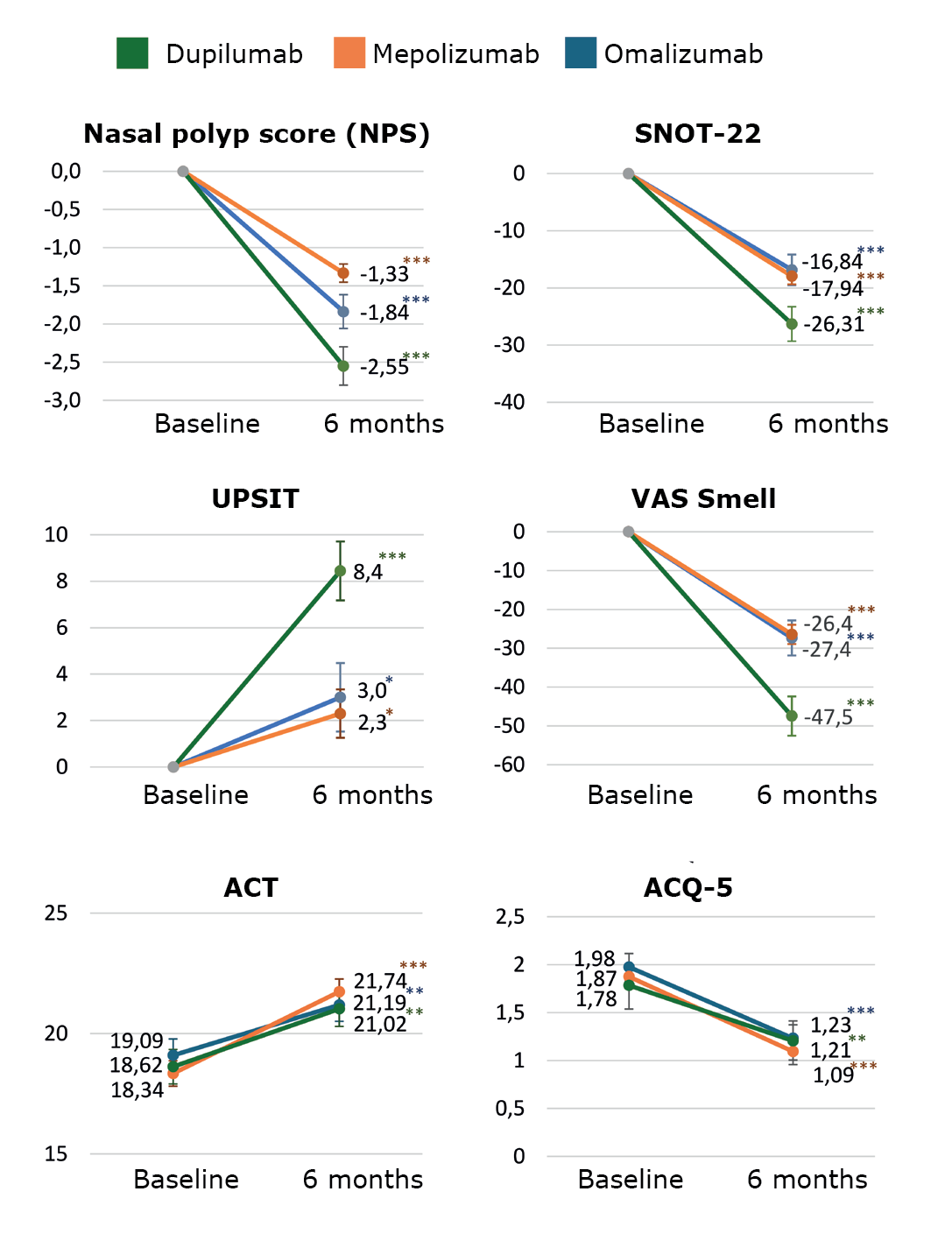
Figure 1. Model-estimated outcomes for key CRSwNP and asthma related measures from baseline to 6 months. A–D are estimated mean changes (± SE) from baseline to 6 months in TNPS (A), SNOT-22 (B), UPSIT (C), and VAS smell (D). Panels E–F are model-estimated marginal means (± SE) at baseline and 6 months for ACT score (E) and ACQ-5 score (F). *p<0.05, **p<0.0, ***p<0.001 within-group changes from baseline. The figure is reproduced by Sanofi based on Blauwblomme M, et al. Rhinology. 2026 Aug 1.

-
Nasal Polyp Score (NPS)
-
SNOT-22
-
Nasal Congestion Score (NCS)
-
Olfactory Function (UPSIT)

Evaluation of the lower airways
Asthma control improved significantly within each treatment, exceeding the minimal clinically important difference. ACT and ACQ-5 scores improved:
- Dupilumab: +2.4 points (ACT), –0.58 (ACQ-5)
- Mepolizumab: +3.4 points (ACT), –0.78 (ACQ-5)
- Omalizumab: +2.1 points (ACT), –0.75 (ACQ-5)

EUFOREA Treatment Response
N=268 (74%) had complete data for all five EUFOREA criteria of treatment response evaluation (TRE). Based on EUFOREA criteria for TRE, overall 51% were classified as good – excellent responders, 46% moderate, and 3% poor responders at 6 months. Response differed between biologics (Figure 2) with good - excellent response rates of
- 41.8% for omalizumab,
- 47.3% for mepolizumab, and
- 77.3% for dupilumab.
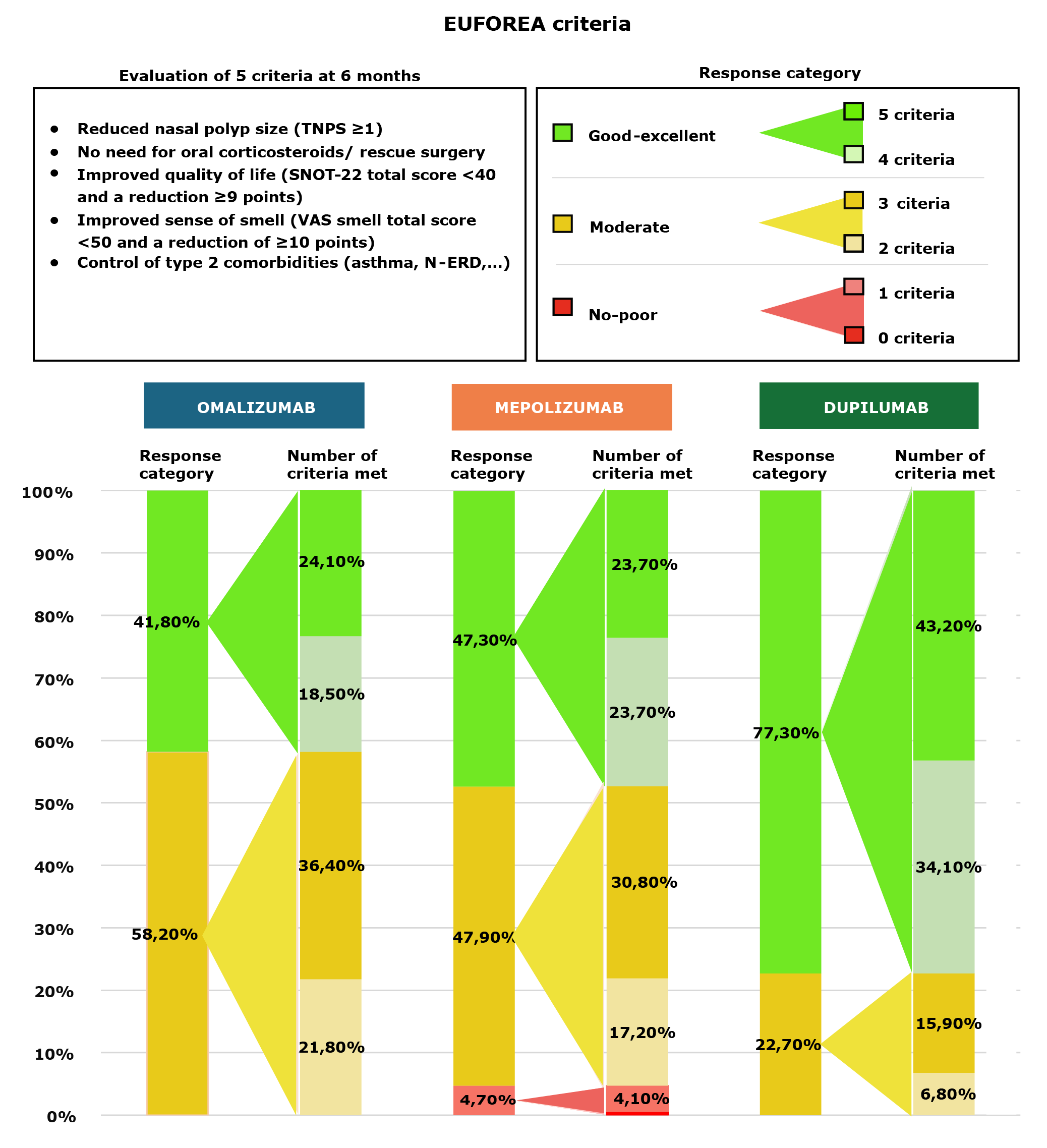
Figure 2. Distribution of EUFOREA Treatment Response Evaluation (TRE) across biologic treatments. Percentages are calculated among patients with complete EUFOREA data. The figure is reproduced by Sanofi based on Blauwblomme M, et al. Rhinology. 2026 Aug 1.
Treatment Continuation and Switching
At 6 months, 81.3% of patients continued their initial biologic, 11.7% switched to a different biologic, and 7.0% discontinued without switching. Continuation rates were highest in the dupilumab group with 92%, compared with 81% for mepolizumab and 74% for omalizumab. No patients initially treated with dupilumab switched to another biologic after 6 months. Most switches were directed toward dupilumab.
Safety
The safety profile was consistent with known profiles. At least one AE was reported by 31.9% (omalizumab), 40.2% (mepolizumab), and 32.6% (dupilumab) of patients. Most were mild and self-limiting (injection-site reactions, headache, myalgia/arthralgia, upper respiratory tract infections). Serious AEs were rare: one discontinuation per dupilumab (a psoriasiform reaction) and mepolizumab (erythema exsudativum multiforme) groups. No biologic demonstrated a distinct safety signal.
Conclusions
In this prospective, non-randomized real-world cohort, all three biologics provided significant within-group clinical benefit in severe CRSwNP across key disease domains. Numerically larger improvements were observed with dupilumab, supported by statistically significant visit-by-treatment interactions across primary outcomes. It is important to note that treatment allocation was non-randomized and baseline characteristics differed between groups. These findings provide real-world context to support clinical decision-making.
-
Bachert C, et al. Lancet. 2019; 394(10209):1638–1650.
-
DUPIXENT Summary of Product Characteristics, 2026.
-
Blauwblomme M, et al. Rhinology. 2026 Aug 1; 64(4):453-462.
-
Lammens J, et al. Rhinology. 2026 Jun 23.



SE-FILMEN-HÄR
