
Patient-Reported Outcome Measures (PROMs) in Dermatology
Interview by DermTalks
DermTalks is a project led with a board of dermatologists and intended to address current challenges, data gaps and emerging trends in dermatology across North-European countries.
Speaker: Prof. Mette Deleuran, Associate Professor and Chair of the Department of Dermatology and Venereology, Aarhus University Hospital, Denmark.
Atopic Dermatitis (AD) is a chronic condition that extends far beyond the clinical symptoms observed during a brief hospital visit. Physical examinations often fail to capture the burden of the disease on a patient's quality of life, including sleep disturbances and social limitations. This is why Patient-Reported Outcome Measures (PROMs) are becoming indispensable tools in modern dermatological practice.
In this DermTalks interview, Prof. Mette Deleuran, Chair of the Department of Dermatology in Aarhus University Hospital, Denmark, discusses the importance of PROMs with Dr. Martta Jokinen, private dermatologist from Helsinki, Finland, and member of the DermTalks Board. Together, they explore how these measures provide a comprehensive understanding of the patient’s daily reality and help facilitate shared decision-making to achieve better long-term control of AD.
Prof. Mette Deleuran has received research support/consulting/advisory board agreements, travel support, and/or honoraria for lectures from AbbVie, Almirall, Eli Lilly, Incyte, Kymab, La Roche-Posay, LEO Pharma, Mustela, Numab Therapeutics AG, Pfizer, Pierre Fabre, Regeneron Pharmaceuticals Inc., Sanofi, and UNION Therapeutics.
Dr. Martta Jokinen has received consultancy fees or participated in a company sponsored event from the following pharmaceutical companies: Janssen, L’Oréal, Novartis, Pfizer, Sanofi, UCB, Almirall.


|
"I think PROMs are very important because patients feel something different when they are at home. When they come to our office, sometimes the skin looks better, but PROMs make us think about how they feel at home […]. It gives us a more holistic approach to what the patient feels about their disease and how well do they think they are controlled with the disease."
Prof. Mette Deleuran - Associate Professor and Chair of the Department of Dermatology and Venereology, Aarhus University Hospital, Denmark |
Understanding the Everyday Life of Patients
Validated tools help clinicians monitor how patients respond to treatment and assess the overall impact of their disease. By incorporating standardized questionnaires into routine practice, healthcare providers can transform patients' subjective experiences into clear, actionable data.
This approach is particularly valuable in dermatology, where tools help make consultations more patient-centered by revealing how skin conditions affect psychological and social well-being. Beyond improving individual patient monitoring, PROMs also provide valuable insights for real-world evidence generation1.
Skin diseases can significantly affect multiple aspects of patients’ daily lives, such as2:
- Everyday Functioning: AD can complicate ordinary life, such as choosing clothing or cleaning the home1,3
- Intimate Life: AD may profoundly affect intimate relationships, with sexual life impacted in 66.0% of patients and 32.5% of partners5
Patient Reported Outcome Measures (PROMs) in Dermatology
Several Patient Reported Outcome Measures (PROMs) are available to support dermatologists in assessing the burden of skin diseases. In her interview, Prof. Mette Deleuran recommends the use of the following scores: DLQI (Dermatology Life Quality Index), POEM (Patient-Oriented Eczema Measure), PP-NRS (Peak Pruritus Numeric Rating Scale) and PO-SCORAD (Patient-Oriented SCORAD).
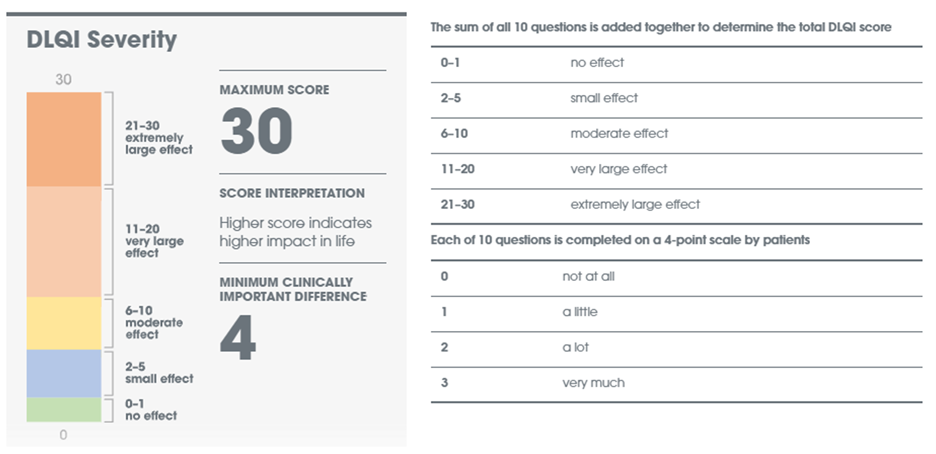
DLQI (Dermatology Life Quality Index)2,3
The DLQI is a widely used, validated measure assessing the impact of skin disease on quality of life. It includes 10 questions covering symptoms, leisure, daily activities, work/school and personal relationships over the past week. It is applicable across dermatologic conditions and easily integrated into routine practice.
POEM (Patient-Oriented Eczema Measure)4,5
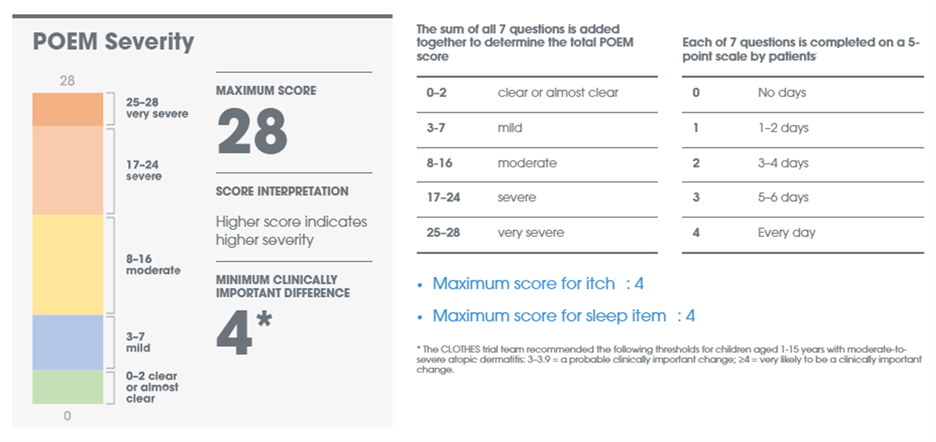
The POEM score is a patient-based measure that provides a comprehensive evaluation of a patient’s perception of the frequency of their symptom. It is a simple, valid, repeatable, and readily understandable patient-oriented assessment measure and allows patients to record how frequently they experience different symptoms during a 1-week period. Seven symptoms were incorporated into the final measure using a 5-point scale of frequency of occurrence during the previous week (pruritus/itch, sleep disturbance, skin bleeding, skin weeping/oozing, skin cracking, skin flaking, skin dryness/roughness). The POEM score captures the fluctuating and chronic nature of atopic dermatitis, provides a comprehensive assessment of symptoms with a significant impact on QoL, including pruritus and sleep disturbance and can be readily incorporated into a general dermatology clinic. Furthermore, using POEM may enable patients to be more actively involved in their disease management.
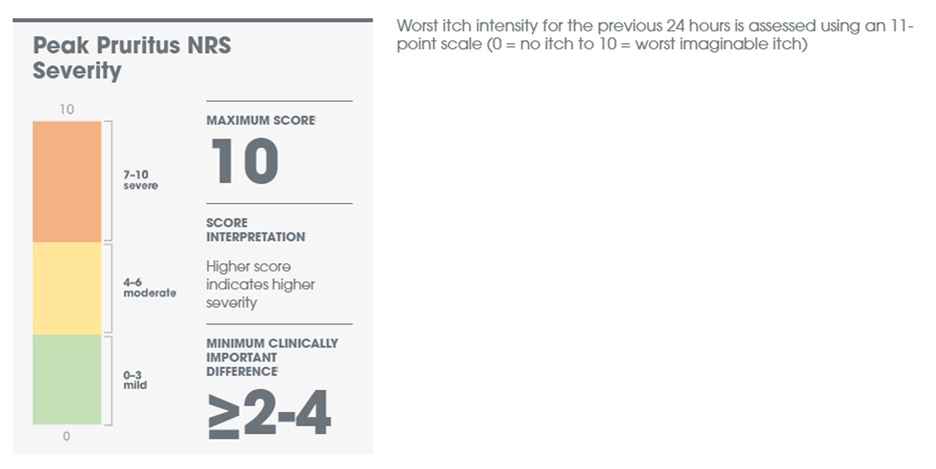
PP-NRS (Peak Pruritus Numeric Rating Scale)6
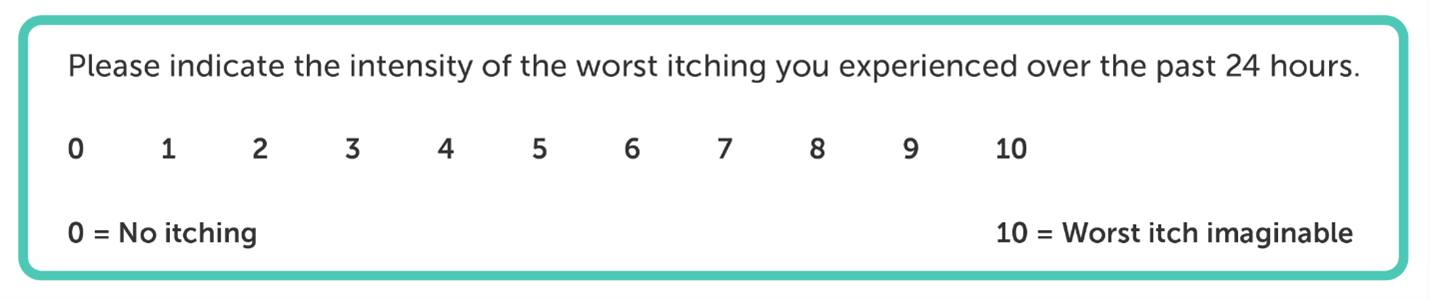
The PP-NRS is a simple tool used to quantify pruritus. It is single-item, patient-reported outcome measure used to assess the intensity of the worst itch over the previous 24h. Patients rate their itch on a scale from 0 ('no itch') to 10 ('worst itch imaginable').
PO-SCORAD (Patient-Oriented SCORAD)7-9
The PO-SCORAD is a self-assessment score allowing patients to comprehensively evaluate their actual course of AD, using objective criteria that evaluate the extent and intensity of lesions, with subjective symptoms such as pruritus and sleep loss. It is derived from the SCORAD, a validated AD severity clinical assessment tool.
-
Available as a standardized application on electronic devices
Disease control tools
To support healthcare professionals and patients in monitoring the long-term management of dermatological diseases, validated disease control tools have been developed to assess the level of disease control achieved over time. These patient-centered instruments provide comprehensive, quantitative evaluations from multiple clinical and patient-reported perspectives.
ADCT (Atopic Dermatitis Control Tool)10
The ADCT is a brief patient self-administered instrument designed and validated to assess AD control. It is also envisaged that the tool will foster patient–clinician communication regarding disease control. In ADCT, 6 aspects are evaluated over the past week, including overall severity of symptoms, days with intense episodes of itching, intensity of bother, problem with sleep, impact on daily activities, and impact on mood or emotions. Each of the items has a score range from 0 (no problem) to 4 (worst).
The total score ranges from 0 to 24, which is the summation of the responses to all the items. A score of ≥7 points is a threshold to identify patients “not in control” at a given timepoint.
PCT (Prurigo Control Test)11
The PCT is the first validated, patient-reported tool for assessing disease control in Prurigo Nodularis (PN) and Chronic Prurigo (CPG). Because uncontrolled PN profoundly impacts a patient’s quality of life, the PCT fills a critical gap in clinical practice, while existing tools measured itch or severity, none specifically measured overall disease control. It is designed for monitoring every two weeks and consists of 5 concise questions (scored 0-4) with a 2-week recall period. These questions cover severity of skin lesions, frequency of scratching, impact on sleep, impact on quality of life, and treatment effectiveness.
The total score ranges from 0 to 20 points, where lower scores indicate poorer disease control.
- ≥ 10 points: Disease is well controlled.
- < 10 points: Disease is poorly controlled.
Practical Implementation Tips
In her interview, Prof. Mette Deleuran highlights practical ways to implement PROMs effectively in clinical practice:
Patient Monitoring, PROMS and Treat-to-Target
The interview highlights the shift toward "Treat-to-target" in dermatology. Treat-to-target is an established strategy in a range of immune-mediated/inflammatory conditions, such as rheumatoid arthritis (RA), spondyloarthopathies, systemic lupus erythematosus, and psoriasis13. In these disease areas, the introduction of biologics led to the development of target-driven treatment algorithms in which specific target goals for treatment response are used to guide decisions to continue, discontinue, or modify treatment(s)13. A clinician-reported outcome alone may not be sufficient as it does not capture the patient’s perspective; therefore, modern T2T approaches deeply integrate Patient-Reported Outcome Measures (PROMs).
Conclusion
Integrating PROMs into AD management shifts the focus from treating a "numerical value" to treating a person. Asking a simple question like "What is most important for you today regarding your disease?" reflect the same philosophy , as it helps clinicians identify patients’ burdens that clinical scores might miss. Ultimately, PROMs support clinicians in addressing what matters most to patients: regaining control of their lives and minimizing the burden of their skin condition.
-
Leshem YA, et al. J Am Acad Dermatol. 2020;82(5):1181-1186.
-
Basra MK, et al. Br J Dermatol. 2008;159(5):997-1035.
-
Finlay AY, et al. Clin Exp Dermatol. 1994;19(3):210-216.
-
Charman CR, et al. Arch Dermatol. 2004;140(12):1513-1519.
-
Misery L, et al. Acta Derm Venereol. 2023;103:adv5285.
-
Yosipovitch G, et al. Br J Dermatol. 2019;181(4):761-769.
-
Severity scoring of atopic dermatitis: the SCORAD index. Consensus Report of the European Task Force on Atopic Dermatitis. Dermatology. 1993;186(1):23-31
-
Stalder JF, et al. Allergy. 2011;66(8):1114-1121.
-
Faye O, et al. J Eur Acad Dermatol Venereol. 2020;34(4):795-799.
-
Simpson E, et al. BMC Dermatol. 2019;19(1):15. Published 2019 Nov 6.
-
Metz M, et al. JAMA Dermatol. 2024;160(2):187-193.
-
Larsen HH, et al. Acta Derm Venereol. 2022;102:adv00760.
-
De Bruin-Weller M, et al. Acta Derm Venereol. 2021;101(2):adv00402.
-
Stahl LS, et al. J Eur Acad Dermatol Venereol. 2025;00:1–10.



SE-FILMEN-HÄR
